WEDNESDAY
18 March 2026
“Unwelcome” Voices
Echoing Through
the Halls of
Tradition


☕ The 2-minute Infusion — Served With a Curious Twist
🐾 The Unkillable Cuddle: Secrets of the Water Bear

“The fossil record shows tardigrades appearing suddenly in the Cambrian period with no clear precursors.”
— Dr. John Morris, geologist

Did the tardigrade and its impressive abilities really evolve gradually from microbes?
Where is evolution here? This creature is said to be unchanged for 600,000,000 years!
These tiny creatures, tardigrades (microscopic “water bears“), can endure freezing, extreme heat, and even the intense radiation and vacuum in space. They arrived “suddenly” and are said to have remained *unchanged* for ~600 million years!
Tardigrades are nature's ultimate survivalists wrapped in a cuddly exoskeleton. Here's a list of their most outstanding traits:
🌌 1. They've Survived Outer Space
- In 2007, tardigrades were blasted into orbit and exposed to the rigours of space, solar and cosmic radiation, and freezing temperatures. Many survived and even reproduced after returning to earth!
🔥❄️ 2. They Endure Extreme Temperatures
- Tardigrades can survive from −272°C (just a little above absolute zero) to over 150°C. That's colder than deep space and hotter than boiling water.
🧟 3. They Enter Cryptobiosis — A Zombie-Like State
- When conditions get tough, they curl into a dry husk called a “tun,” suspending metabolism almost completely. In this state, they can survive decades without food or water.
🦠 4. They've Been Around for 600 million Years
- Tardigrades are said to predate dinosaurs by millions of years. They've weathered all the “mass extinction” events that scientists believe have wiped out multitudes of species, perhaps via the collision of an asteroid with earth, or by some other catastrophe.
🧪 5. They're Radiation-Resistant
- These tiny creatures can withstand radiation doses hundreds of times higher than levels that would kill a human.
🧭 6. They Live Practically Everywhere
- From Himalayan peaks to deep-sea trenches, Antarctic ice to tropical rainforests, tardigrades thrive in moss, lichen, soil, and even hot springs.
🧠 7. Their Bodies Are Mostly “Head”
- They don't have the middle body segments typical of other creatures. Their entire body is essentially a walking head, anatomically speaking.
🐾 8. They Walk Like Bears
- Their lumbering gait and clawed feet resemble a bear's walk — hence their nickname “water bear.”
🧫 9. They're Translucent and Tiny
- Most are a fraction of a millimetre long — just visible to the naked eye — and many are translucent, making them hard to spot without a microscope.
🧃 10. They Feed by Piercing Microscopic Cells
- Tardigrades use dagger-like mouth-parts to pierce plant cells, algae, or even other tardigrades, then suck out the contents like microscopic vampires.
Mainstream evolutionary narratives lean heavily on the concept of incremental changes across immense spans of geologic time. But the tardigrade defies this theory in spades! They have retained key anatomical traits for over half a billion years. This takes palaeontologists back in time to what they call the Ediacaran Period (541–635 million years ago), which is said to have marked the dawn of complex multicellular life.
With all the advanced characteristics that tardigrades manifest, to this day, they are advanced with the so-called “evolutionary traits”? Where did these come from? Yet why are they “unchanged” in the face of the gradual, incremental changes that are touted to support evolutionary theory?
Additionally, why are there no effective transitional forms that give rise to their incredible abilities? The answer given by evolutionists is most often along the lines of 'fossilization is a rare event and the fossil record cannot be expected to contain a complete, uninterrupted sequence of evolution.'
However, the oft-cited phrase 'cannot be expected' — when used by evolutionists to explain missing transitional fossils — betrays the weakness of the argumentation as it indirectly acknowledges the incompleteness of the fossil record. If this foundational record is a “poor representation” and riddled with “significant gaps,” it must be asked: Where is the empirical foundation for the theory if it is not from the fossil record, and: What other pillars fail to provide support for the evolutionary framework? — (See the full article Mutations: Are They “Raw Materials” for Evolution?' available in the book.)
The Potent Paradox

Orthodox evolution effectively says:
"Life created the conditions
for the arrival of life."
🎲 Chaos, Eloquently Explained
Life, we are told, is the outcome of random events sculpted by natural selection. Yet the deeper we look, the stranger this story becomes. Traditional evolution is presented, not merely as a process acting on life, but as a pattern that undertook to prepare the stage before life ever arrived; a series of inter-related, layered mechanisms that preceded their own existence. This is the paradox at the heart of tradition’s most widely accepted biological narrative. — (See 'Emergence Before Mechanism' below.)
(Note that this article is not a rejection of science, but a critique of the inadequate conclusions of orthodox evolution.)
✍️ The Algorithm that Wrote Itself
The paradox lies in the observation that the very architectures — the ordered laws, consistent principles, fine-tuned constants, the information-rich systems — used to explain the natural phenomena around and within us, exhibit characteristics that undermine the explanations provided by orthodox evolution.
Supporters of evolution seek to explain these characteristics (that are self-sufficient, self-repairing and persistent) using blind, directionless processes they are powerless to duplicate. The more successful experiments that seek to match theoretical models only serve to provide empirical proof of the requirement for intentional management of ordered and formatted design — especially to the degree of the impressive, sophisticated and intricate designs manifest in nature.
🧬 The Semantics That Betray Purpose
The deeper scientists venture into molecular mechanisms, the more the lexicon resembles that of engineering, computation, authorship:
DNA is a “code” ... Ribosomes “translate” ... Enzymes “edit” ... Cells “signal.”
Additional examples include:
- “Messenger RNA” conveys the idea of purposeful delivery of information.
- “Promoter regions” suggest initiation points, like a start button.
- “Enhancers & silencers” imply regulatory control, akin to volume knobs or switches.
- “Proofreading enzymes” suggest editorial review and correction.
- “Splicing” evokes film editing and modular assembly.
- “Protein folding” implies origami-like precision, foresight and purposeful structure.
- “Scaffold proteins” suggest structural frameworks for organisation.
- “Gene regulatory networks” suggest governance and orchestration.
- “Feedback loops” imply self-regulation and adaptive control.
- “Cells ‘decide’ to differentiate” suggests volition or choice.
These terms are not poetic flourishes; they are embedded in the technical language of science's laboratory protocols and peer-reviewed literature.
🎩 Instructions Not Included
This semantic architecture is not neutral. It carries conceptual baggage: the implication of purpose, coordination, and teleological (future awareness) design. When scientists describe transcription errors (biological typos) as “mutations,” or refer to “proofreading” enzymes, or “regulatory networks,” they invoke a framework that presupposes a standard, a calibrated deviation, a planned corrective mechanism that foresees any potential future mistakes and aberrations. These are hallmarks of systems designed with forethought.
The late Sir Francis Crick (British theoretical molecular biologist) famously remarked that “biologists must constantly keep in mind that what they see was not designed, but rather evolved.” The irony is palpable. The very need for such a disclaimer indicates that the phenomena under observation persistently evoke the appearance and notion of design. Crick’s caution is not a scientific conclusion; it's a philosophical precommitment, an appeal for readers to turn away from alternative conclusions, irrespective of the potential scientific value of those conclusions.
This linguistic paradox reveals a deeper tension: the tools of description betray the assumptions of the describer. If biology is a language, then its grammar is teleological — with characteristics of forethought and planning — even when its authors insist otherwise.
⚛️ Cosmic Coin Toss
Beyond biology, the physical scaffolding of life presents its own conundrum. The universe appears to be exquisitely calibrated for specific complexity. For example:
- The calibrated variable strength of gravity at every incremental distance, stretching to infinity at ever reducing values (see the article 'The Enigma of Einstein's Gravity').
- The balanced and precision-calibrated strength, yet fixed range, of the strong nuclear force (which is around 10³⁸ times greater than gravity).
- The precise ratio of the size of the electron to the proton.
- The consistent charge of every electron in the universe.
- The ratio of dark energy (ΩΛ) (or its latest theoretical equivalent).
These few examples fall within extremely narrow bands to permit the successful emergence of stars, chemistry, life, and consciousness. (See the article ‘Was the Universe Fine-tuned for Life?’) A slight deviation in any of these constants would render the cosmos inert or chaotic, and life itself either impossible or meagre.
This fine-tuning problem is not merely a philosophical or theological talking point — it is a recognised puzzle in cosmology and theoretical physics. The ”anthropic principle” (the idea that the universe must be the way it is — finely tuned for life — because we’re here to observe it) attempts to sidestep the issue by suggesting that “we observe a life-permitting universe because only such a universe allows observers.“ But this is a tautology, not an explanation. It describes the conditions that exist to permit observation, without accounting for their origin. — (See the discussion on 'Has Fine-tuning Been “Debunked”?')
🔁 Emergence Before Mechanism
One of the most profound paradoxes in evolutionary theory lies in its attempt to explain the emergence of the very mechanisms it infers — those that are said to make evolution possible ... a self-referential dilemma!
For example, the genetic code, the cellular machinery that interprets it, and the metabolic systems that sustain it — all must exist before “natural selection” can operate. Yet evolutionary theory seeks to account for their origin using the very processes that presuppose them.
This is a form of “epistemic recursion”: a system that supports itself by its own bootstraps (where the phrase “booting a computer” comes from), or a house that builds itself using its own blueprints. It’s akin to a book writing its own grammar, a language inventing and describing its own syntax, or an AI (Artificial Intelligence) system compiling its own operating system from raw materials. Absurd, perhaps? Yet that is the reality that traditional evolution effectively portrays!
Orthodox evolution also effectively says, “life created the conditions for the arrival of life,” or the “brain learned to rewire itself.” The theorists also sponsor other circular claims. Here are a few examples:
👀 “Consciousness emerged because matter became sufficiently complex to notice itself.”
This treats self‑awareness as a passive by‑product of complexity, even though “noticing” already presupposes the fortuitous arrival of such complexity, as well as a subject capable of noticing — hence, another circular argument.
🙀 “Creatures survived because they developed survival instincts.”
But the development of such specific instincts presupposes not only intelligence, but some prior capacity to persist long enough to develop anything at all.
🧾 “Language evolved because early humans began communicating more effectively.”
But “communicating effectively” already assumes proto‑linguistic structure, intentional signalling, and shared meaning.
⚛️ “Cells organised themselves into multicellular organisms because cooperation was advantageous.”
But such cooperation presupposes signalling, coordination, and boundary‑determinations — capacities that only make sense after multicellularity, self-awareness, and intelligence somehow “emerge.”
🐣 “Mammals gave up on laying eggs because live birth was advantageous.”
This treats a major anatomical, developmental, and genetic transformation as if it occurred by multiple consecutive fortuitous events; as if mammals had the simplistic choice of opting for one reproductive method over another. Such a change requires coordinated functionality: a fully operational placenta, innovations in maternal–foetal signalling, immune tolerance, nutrient transfer, extensive blood and nerve fibre integration, among many other considerations; for example, it also requires a re-coding of the instructions in the genome. The many “incremental changes over considerable time” claimed by evolutionists do not help; after all, why would natural selection select any half-developed incomplete component of such a complex and critical system? (See also the article 'Sex Without an Ancestor: The Void No Theory Fills' available in the book.)
The question of the origin of life is not merely a chemical conundrum — it's a problem involving symbolic logic and information management. It's a question of functional integration of multi-layered specified complexity of such extensive depth and component inter-dependency that it defies imagination.
This self-referential dilemma demonstrates that the architecture of life cannot be reducible to a blind, undirected mechanism. Instead it reflects a deeper and more intelligent principle: one in which employable complex systems are not somehow assembled following their fortuitous arrival, but in contrast are instantiated with the potential, the capacity for perpetuity and a calibrated measure of variety and self-transformation.
In this view, evolution is not the origin of design — its core narratives compete with the expression of a design embedded deep in the core fabric of the natural world.

Evolutionists seek to account for the origin of design features using the very processes that presuppose them!
The intelligent input developed by evolutionists inadvertently adds weight
to the empirical evidence
for intentional order and planning.

Life is instantiated with the capacity
for perpetuity and a measure of
variety and self-transformation.
Could a house produce its own
blueprints and then build itself?

The Symphony Before the Score
The traditional account of life’s origins paints a picture that begins with a calm earth, a warm pond, a gentle spark; then comes a “fortuitous event” followed by a slow unfurling that eventually results in life’s variety that fills the panorama of our vision today.
But the indisputable mathematics behind just one development, that of the origin of proteins within our cells, tells a different story! These odds are not just long, they are astonishing. And as these values come into focus in context, the usual narrative of life’s spontaneous arrival begins to unravel thread by thread…
The arrival of even one successful protein pushes probability well past any breaking point. And once the true scale and nature of the problem is revealed, the familiar story begins to look less and less like science and more and more like a comforting myth!
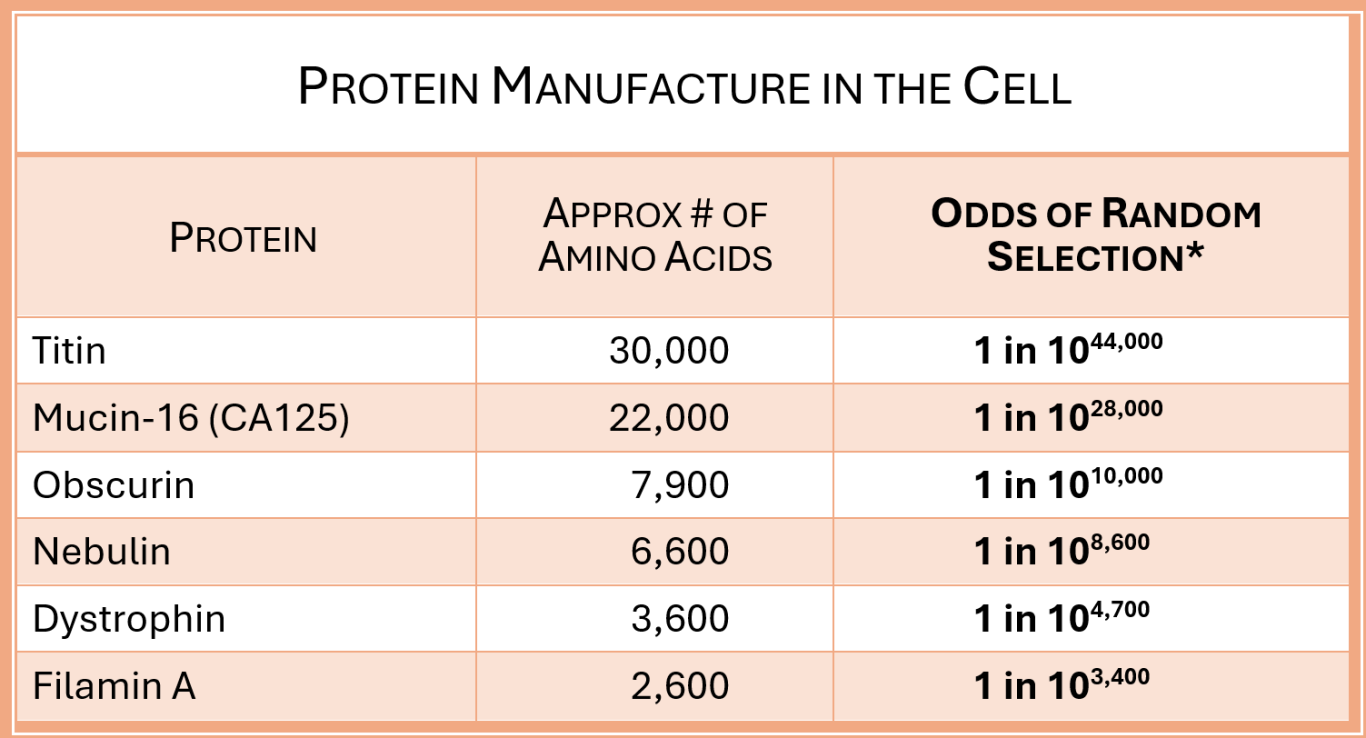
*[Technical Note A:] The odds listed here concern the amino acid sequences as encoded in our DNA, and the chart regards each one simply as a single linear chain. Inside a human cell, the organic “machinery” that selects and links amino acids into a growing polypeptide chain does not operate by random selection for each amino acid — it follows instructions, already embedded in the DNA, which specify the next amino acid that is added at each step; and this is performed with the assistance of cellular machinery. This is not what the odds in the chart are based on. The cell’s translation system relies on information that is already present. The improbabilities in the above table arise, not from the routine, device-assisted action of building proteins, but from the specifications for the original amino acid sequences, as well as the instructional coding for the accompanying specialised cell machinery, that were written into DNA in the first place. — (For additional technical info, see our science paper on the origin of proteins.)
These facts light the fuse that leads to the $64,000 questions: By what means did the chemistry of the cell write the instructional code into the genome originally? Using the evolutionary model, would the cell have also encoded each unsuccessful (attempted) amino acid sequence? Highly unlikely! But how and when was the workable successful sequence written into the permanent record of DNA to seal the mould for the manufacture of all future proteins of each type?
A Practical Impossibility!
Each of the above odds towers so far beyond the realm of plausibility that they render the notion of human life arising by undirected events not just highly improbable, but mathematically absurd and in practical terms impossible.
By way of comparison, imagine taking two decks of playing cards (containing the standard 52 cards), giving each a perfect shuffle, and then dealing them out separately. Mathematicians reveal the probability that both decks emerge in precisely the same order as more than 1 in 10^68 — a figure so extraordinarily small that for all practical purposes it is treated as impossible (for example, the universe itself is said to be only 10^17 seconds old!)
Yet, this figure of 1 in 10^68 is a paltry amount when compared to each of the values in the above chart!
*[Technical Note B:] Critics of this type of numbers-based argumentation often respond that extreme improbability is not the same as impossibility, and dismiss such calculations as irrelevant to their theory. However, a comprehensive study of the points raised in this article reveals that these arguments cannot be so easily dismissed!
A common counter‑argument used by evolutionists is that the emergence of the original method for the manufacture of functional proteins did not occur via random events, but unfolded through “natural,” “holistic” chemical pathways that supposedly could not have produced any arrangement other than the one we observe! However, this defence presupposes the very mechanisms under debate. Evolutionary explanations of protein formation typically appeal to the cellular machinery that interprets, assembles, and regulates protein manufacture — machinery that is built using instructional code that was also originally written into DNA.
This is the crucial point: The improbabilities presented in the ‘Protein Manufacture in the Body’ table above do not merely concern the formation of single proteins. They encompass the origin of the specialised coding system, translation apparatus, and regulatory architecture required to design and construct the protein manufacturing process itself, a process that had to be already fully functional in order to build these proteins in the first place. Any argument that invokes existing biological machinery to explain the emergence of that very machinery exhibits circularity, commonly called a Catch-22 situation. (See the article 'Evolution: The Ultimate Paradox.') The following question therefore requires careful thought:
How did the essential system that is required to produce such proteins work successfully before the system itself existed?
The traditional narrative says: “by means of incremental changes”; ... … really?
Where Supercomputers Do Not Begin to Compare!
Consider random selection for a moment: even the above tiny subset of six of the proteins that our bodies assemble continuously — each composed of thousands of amino acids arranged in specific stable sequences — represents a combination so vast that it dwarfs astronomical numbers by multiple orders of magnitude!
To merely count through any one of the numbers in the chart to completion, even a modern supercomputer would require considerably more time than the age of the universe — in fact, many times over! These values don’t just challenge our intuition; they defy the very limits of practical computation. And yet in a way our cells deal with these numbers with consummate ease!
Moreover, the chart lists just six protein types; exceptionally high improbabilities must also succeed across each of the other unlisted protein types (estimated to number somewhere between 20,000 and 100,000, with biologists suggesting it could in fact reach into the millions of types) that our bodies assemble with transcendent ease. As an example, among the smallest of our proteins is insulin, with 51 amino acids. The odds of randomly selecting this relatively small sequence as a single linear chain are 1 in 2.6 × 10⁶⁶ — odds that make the above card-shuffling example seem quite trivial by comparison! If, as evolutionists propose, a physical process facilitated these selections that became indelibly encoded in DNA, then it must be asked: How was this facilitating process itself developed and constructed?
If an intelligent rational thinker is to be adequately convinced that orthodox evolution could account for the original selection of these amino acid sequences, then either these improbabilities must be realised at the same time, or the existence of the initial complex design mechanisms must be demonstrated, not by conjecture, but using empirical science! Note that missing even a few of these proteins would result in serious consequences ranging from significantly diminished quality of life to the impossibility of life ever arising! (See the examples in the science paper under the heading 'Cellular Interdependence and Orchestration'.) In this way, the above “odds” are compounded exponentially.
And, again, remember that we are here discussing the original development of the mechanism for building each protein type and its associated biological “machinery,” not the routine assembly of individual proteins that evolutionists refer to in response!

The eons of time proposed would not enable proteins to work at the same time, in concert.
The development of protein manufacturing within the cell is not merely a case of handling random events; it involves the exponential compounding of extremely high improbabilities as well as applying complex order and specific arrangement to many layers of connected functionality. The vast geological timescales invoked by evolutionary theory offer no refuge here, inasmuch as far too many of our proteins are interdependent, mutually reliant, and therefore must function simultaneously within the cell to be of any value to the body.
The eons of time proposed in the evolutionary narratives would not enable these proteins to fulfil their respective tasks in concert: The development of each of these proteins must be completed at the same time! (For a technical view, see the science paper under the heading 'Cellular Interdependence and Orchestration'.)
Even if we assume that multiple “successive, slight modifications” (as Charles Darwin put it in Origin of Species) could somehow accomplish this specified choreography, the claimed vast evolutionary ages would prove insufficient for even a fractional success!
A Walk Around the Galaxy!
But the above extraordinary odds are in fact a walk in the park compared to what happens next! Amino acid selection is overshadowed by the complexity of three-dimensional folding. Proteins do not remain as linear strings, but each one must be folded into a unique 3D shape before it can begin its assigned tasks within the cell.
Consider this: It's estimated that our sun takes around 250 million years to orbit the centre of the Milky Way. This is only 20 galactic years in its lifetime! The appeal to immense geological timescales does not support the evolutionary narratives, as there is insufficient time for undirected events to successfully develop human proteins.

Artist's impression of the protein Titin — a single molecule!
In summary: Protein manufacture is a two-stage process: (a) linking the correct sequence of amino acids into a linear chain, then (b) folding this chain into a specific shape.
This second phase, Part B, is so complex that the AlphaFold project — an international collaboration of many scientists (now more than two million strong) along with a team of computer programmers — has spent years calculating how to theoretically achieve what the cell actually achieves instantaneously, quintillions of times per second in our many cells! (Note: the yet more intricate Part C is outlined later!)
Protein Development Required a Chorus, Not a Solo
As noted, evolutionists theorise that complexity emerged over vast stretches of time, with “numerous, successive, slight modifications." As the arrangements of the original amino acid sequences are assumed to have been undirected, the burning question is: Why, in the earlier stages, would evolution “select” a redundant (useless) string of amino acids? Without the subsequent highly complex and specific 3D folding process that transforms these irregular linear chains into functional proteins, such strings would offer no utility to the organism. For this reason, asserting that undirected evolution gradually assembled the machinery for protein synthesis only deepens the enigma. Until the completed architecture of the folding mechanism was established, the chains of half-formed polypeptides were biologically inert, offering nothing useful.
As an example, consider a factory that manufactures sophisticated vehicles gathering millions of components to build an intricate spacecraft, without the engineers knowing how to put the pieces together, or even what each finished part will do functionally on behalf of the completed craft!
No Feedback Mechanism = No Re-configuration Attempts
The above considerations lead us to additional pointed questions: Why do our bodies no longer make protein re-configuration attempts? Is it not because each protein is a finished product? But how could a blind process determine the nature of a “finished product”? How did evolution arrive at the construction for each “finished product” by establishing the correct formation for each of these protein types; i.e. during the eons of gradual evolution, and the many unsuccessful attempts at the original protein development mechanism, how could it be ascertained that success had been achieved for each construction? By what feedback mechanism did successful construction seal the established design of each of these components, so that further configuration changes (“numerous, successive, slight modifications" as Darwin put it) were no longer made? The alternative is for evolution to possess knowledge; to “know” the precise amino acid sequence followed by the particular folding mechanism in order to adequately fulfil each protein type's target function! Is it not clear that a blind process could not have the capacity to “anticipate” the required function for each protein?
And, again, remember that we are here discussing the original development of the mechanism for building each protein type, not the routine assembly of individual proteins that evolutionary narratives return to!
The successful solution, to both the required sequence of amino acids and the correct folding algorithm to provide every protein with its final 3D form, is no small accomplishment. Yet a final hurdle remains, which makes the first two phases themselves, even when combined, seem like “a walk in the park”! How did evolution convert these established creation mechanisms into the required code for the cell's DNA to use multiple procedures that were to become permanent for every protein type and each appropriate cell?
A Profound Puzzle at Evolution's Core
Let us take a detour for a few moments to investigate the implications lurking within the standard evolutionary narratives:
If undirected events were truly involved in this process, we're left to envision evolution tirelessly reconfiguring a protein until, by chance, a viable structure materialises. But ponder for a moment on this thought: What is it that prompts these attempts to be made at all? What cellular mechanism would drive the generation of multiple new amino-acid-chains without an inkling that a successful functional outcome awaits to reward these considerable efforts? The theory posits that countless non-viable sequences must have arisen — each a biochemical cul-de-sac, discarded in the march toward success.
Let's explore further: Did evolution implicitly "know" that a particular target — a novel protein type — lay hidden, that would not only prove beneficial to the cell but vital to its functionality? Was there, on some level, an awareness of the *need* for a protein of a specific design? Evolutionary theorists would not contemplate such a possibility!
In the absence of choreographed construction, this leaves randomness as the principle mechanism. But what of the immense volume of non-functional amino-acid strings produced en route? Were they synthesised, folded, tested and upon failure purged one after another? Did cells persistently experiment with random chains because of the “perception” that a useful component would inevitably emerge? In fact, would a component that is merely “useful” even suffice? Note the following:
All proteins perform a specific function for the cell, and yet there are no proteins whose functionality is superfluous to it!
Take titin discussed earlier, the colossal muscle protein consisting of more than 30,000 amino acids. The explosion of possibilities for such a sequence — around the order of one chance in 10^44,000 — dwarfs even multiple cosmic scales, implying an untenable cascade of failed trials that would swamp cells with unmanageable dysfunctional debris.
Does this traditional depiction of protein development origins — an unrelenting torrent of random sequences, fruitless experiments, and molecular waste — genuinely square with the genesis of our body's intricate and comprehensive collection of proteins? Or does it expose a profound puzzle at evolution's core, where the compounded improbabilities strain credulity; especially amid claims of gradual, selected refinements occurring over vast stretches of time?
DNA has no chemical laboratory testing equipment or feedback mechanisms, it's a complete and thorough information repository; the genome is not an architect, it's an archive; and evolution is not a designer — it does not aim, foresee, or intend!

Could this factory succeed if the engineers had no idea
what each component's function was going to be?
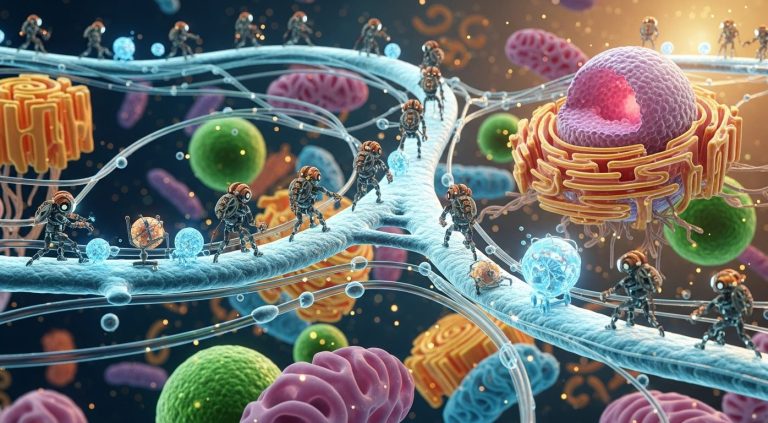
The conceptual image here, of a large factory floor strewn with disconnected machinery, structures and parts, offers only a crude reflection of the complexity within a human cell; each cell in its own turn being a contributor among trillions that comprise a single body. In this article, we have focused solely on proteins; yet proteins are just one class of actors in a cellular drama teeming with specialised components, each with its own role to play in the choreography of life. Within the cell, countless other ingredients find their place in this molecular metropolis (enzymes, histones, ribosomes, endosomes, melanosomes, chromatin, lysosomes, peroxisomes, proteasomes, centrosomes, centrioles, vacuoles, microvilli, cilia, flagella, chloroplasts, plastids, etc.) — with more components even now being continually discovered in the field of microbiology.
Evolutionary biologists are endeavouring to unravel all the functions and interactions of proteins — yet even the question of the full number of these parts remains elusive (possibly reaching into the millions of protein types); and the successful orchestration of their combined functionality remains beyond any laboratory or computer replication!
The cell is not just complex, it is also coherent — a system whose unity defies reduction, whose parts do not merely coexist but function harmoniously. It is not a random collection of fortuitous mechanisms, but a choreography of essential interactive functions that serve an overall purpose: the maintenance of the conscious life to which they belong!
These impossible odds and the associated empirical facts included above, fly in the face of the proposition that proteins arrived by undirected events!
And finally, the above considerations are merely a drop in the ocean of improbabilities that can be found in the cosmos, the solar system, the earth, and the biology of life. To accept the traditional narratives in the face of such layered interdependent specified complexity, is to stretch plausibility in multiple directions light-years beyond the boundaries of reasonable inference!
(If you are a student in the field of biology or cosmology or another branch of physics,
you may wish to review our paper which forms the scientific basis for this article.)
Echoes Across the Domains
Mistrust in Orthodox Evolution
Why should the same design principles emerge in such radically different contexts? Why should the fractal logic of fern leafage mirror the dendritic spread of a river delta? Why should the compound eye of a fly echo the tessellated geometry of crystalline quartz? These are not superficial resemblances — they are deep symmetries; convergences of form and function that indicate a unifying grammar beneath the surface diversity.
In the architecture of nature, certain motifs recur with extraordinary fidelity — spirals in galaxies and snail shells, symmetry in snowflakes and starfish, fractal branching in veins and lightning. These patterns do not respect taxonomic boundaries or material substrates. They leap across kingdoms, classes, forms and elements, showing up in minerals, microbes, mammals, and even in the laws that govern motion, light, gravity and the behaviour of galaxies. Their recurrence is not merely aesthetic — it's structural, functional, and mathematically precise.


Evolutionary theory attributes such similarities to convergent natural selection: the idea that similar environmental pressures sculpt similar solutions. But this explanation, elegant in its simplicity, begins to fray when the convergences span not just species or ecosystems, but entire domains of existence — when the same motifs appear in animate and inanimate matter, in biological systems and physical laws, in the microcosm and the macrocosm; e.g. when the characteristics of sexual reproduction and the maturation of young are found in every branch of Darwin's “Tree of Life.” — (See the discussion on the problems this poses for orthodox evolution in the article 'The Origin of Sexual Reproduction: A Puzzle with No Precursor' available in the book.)
This website explores these cross-domain design echoes — not as anomalies, but as clues. Clues that the universe is governed not by blind chance and incremental adaptation, but by deeper principles of order, resonance, and constraint; principles that weave a tapestry of consistent form, and a foundational framework so finely tuned that the axiom that its emergence was by accident strains the boundaries of credulity.
We will examine examples from biology, geology, physics, and cosmology — each a case study in the consistent recurrence of form. And we will ask: Did such complexity and order really arise by means of the evolutionary mechanisms of natural selection and survival of the fittest, according to the current theories of unchallenged orthodoxy? Or does the evidence point to something more — an architecture of reality that is not merely functional, but profoundly deeper than the orthodox narratives?