From Atoms to Galaxies to Life
An examination of the empirical evidence that overshadows Darwinian evolution
This section scrutinises the foundational assumptions of orthodox evolution, not just through the lens of empirical enquiry but via a conceptual tribunal — a mediation panel convened to interrogate the coherence, viability, and implications of the mainstream view of the origin of life.
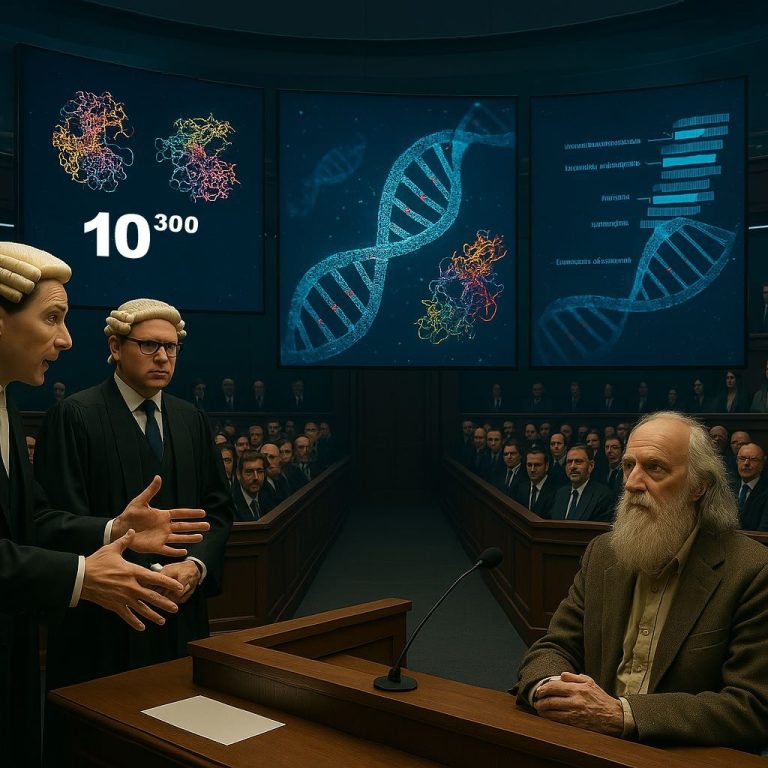
An "Exquisite Symphonic Masterpiece"
This section scrutinises the foundational assumptions of orthodox evolution, not just through the lens of empirical enquiry but via a conceptual tribunal — a mediation panel convened to interrogate the coherence, viability, and implications of the mainstream view of the origin of life.
Take DNA, for instance, often heralded as the “Blueprint for Life.” This, and other descriptions, underscore the observations that DNA does not resemble a random scatter of biochemical incidents. Rather, it evokes the qualities of channelled order, empirical perceptions of organised arrangement: a lexicon of nucleotides arranged with syntactic precision. A choreography of molecular interactions that unfold with temporal coordination, and a classification system that anticipates future cellular needs (see the article 'The Symphony Before the Composition').
This orchestration suggests more than mere survival optimisation. It has the hallmarks of intentional arrangement — a layered hierarchy of information and functionality that manifest foresight. The genome is not just a passive ledger of ancestral form; it is a dynamic script, capable of self-repair, contextual expression, and intergenerational transmission. In this light, DNA resembles not a blind algorithm but a symphonic score — one that plays out across time, physical boundaries, animal species, and ecosystems with astonishing fidelity.
To call it “exquisite” is not hyperbole. It is to acknowledge the aesthetic and structural elegance embedded in biological systems — an elegance that invites us to ask: Is this the product of stochastic drift, or does it hint at deeper principles, a logic of emergence that transcends the reductionist views? To investigate these themes further, examine the following considerations:
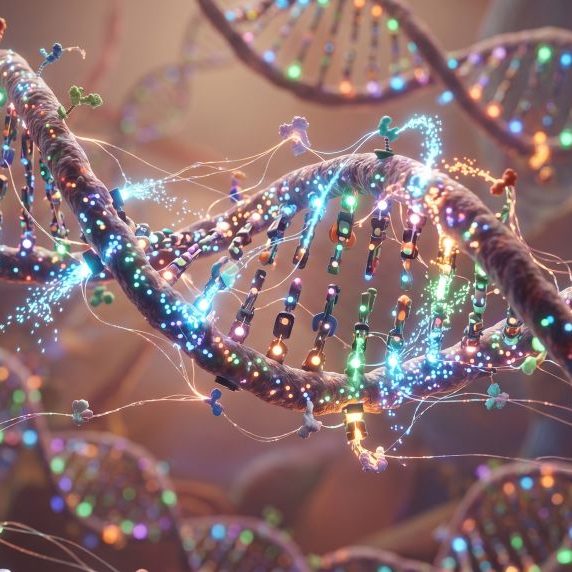
DNA
A Complete Instruction Manual
The above image is a representation of the "code" of DNA.
Each "piece" of this 3+ billion molecule strand is like a single letter in an immensely large and comprehensive instruction manual.
Only by :
- building all of these "letters" into meaningful words,
- and then each word into an intelligent sentence,
- and checking and coordinating the intention and meaning of each sentence,
can the entire "manual" begin to make sense in the construction and regular maintenance of a complete individual: whether human, animal, vegetable, or bacteria.
This orchestration suggests more than mere survival optimisation. It has the hallmarks of intentional arrangement — a layered hierarchy of information, function, and foresight. The genome is not just a passive ledger of ancestral mutations; it is a dynamic script, capable of self-repair, contextual expression, and intergenerational transmission. In this light, DNA resembles not a blind algorithm but a symphonic score — one that plays out across time, physical boundaries, animal species, and ecosystems with astonishing fidelity.
How does this fit in with the vast timelines (said to span more than a billion years) of exceptionally gradual evolution that added complex designs in a “staged” manner?
Consider for a few moments the computer coding required to create an AI (Artificial Intelligence) system. One source says that an up to date AI can be composed of BILLIONS of lines of instructional code. Even a single drone in the US military consists of 3.5 MILLION lines. And just one coding error amongst all these many lines could render the device completely useless. But with the help of intelligent, skilled (and expensive) programmers, these "bugs" are continually found, corrected, and retested, until the code works according to requirements. These corrections are made, not by chance, but by a coordinated effort involving highly skilled and experienced programmers.
One complex aspect of computer coding that programmers must deal with, is "self-referencing," where one piece of code makes reference to another, distant piece of code. DNA, however, manages this complexity with ease.
How was the coding, used in DNA, constructed? How could it reference biological code that occurs in a different location within the DNA? Where did the mechanism come from to produce such complex, ordered, and complete functionality?
Protein Molecules
Outrageously Complex
Proteins are constantly being assembled and deployed throughout our bodies. But these molecular machines are anything but simple. Some are outrageously complex—labyrinthian citadels of chemistry built from thousands of interlocking and specifically sequenced parts.
Once constructed inside the cell, a protein doesn’t remain a mere string. It is folded into a precise three-dimensional shape, guided by determined laws of physics and chemistry. And that shape decides its function within the cell.
One protein can have thousands of potential folds, each influenced by the sequence of amino acids and the surrounding cellular environment.
Consider the following pointed questions:
How and when were the workable successful sequences of amino acids, for each protein, written into the permanent record of DNA?
How did the essential system that is required to produce each protein type work successfully before the system itself existed?
Why do our bodies no longer attempt protein re-configurations?
How could a blind process determine the nature of the “finished product” of each protein type?
How could evolution anticipate the required function within the cell for each protein?
Could life’s "spontaneous" rise succeed if evolution designed proteins without having any insight into the role each one would ultimately play in the finished cellular symphony?
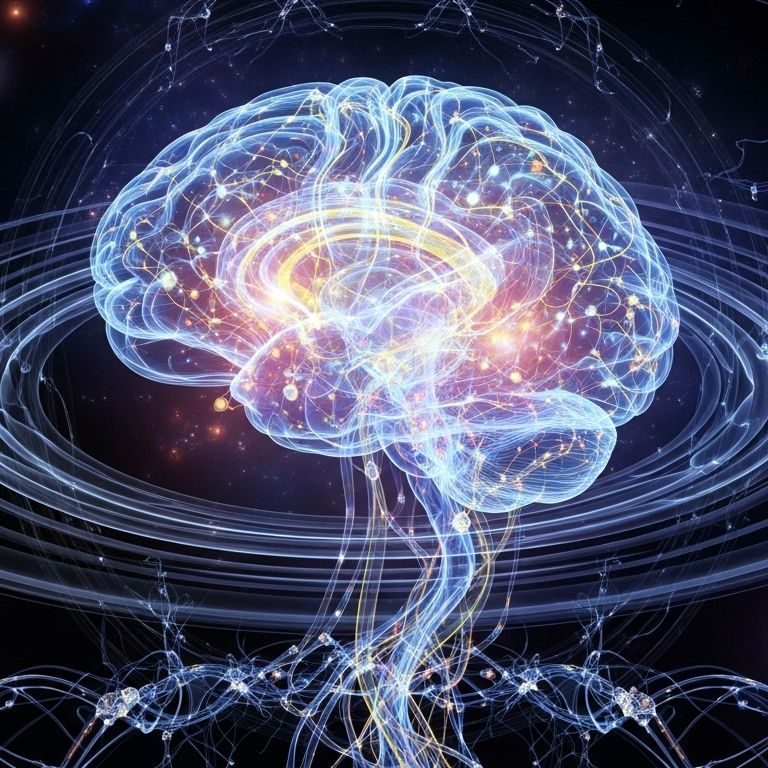
The Human Brain
Intricacy Exemplified
The human brain, scientists say, is the "most complex thing we have yet discovered in our universe."
Interestingly, computer experts have been working on building their own equivalent of the brain. Their plan is to model their creation on the neurons of the brain and the many interconnections formed between them.
More recently, however, a considerable blow has been delivered to this effort. It is now known that neurons are many times more complex than previously thought. There are around 86 billion of these in each human brain. But within every neuron there are thousands of microtubules (see below), each assisting in sending and receiving data communications millions of times faster than inter-neuron firing.
Recent research on microtubules has shed new light on the complexity of the human brain. It operates on just 15 watts of power (less than a light bulb), yet a single brain has more potential connections than there are stars in the universe!
When considering the amazing features of the human brain, neuroscientist Andrew Huberman said: "You just don't see in animals the elaboration of parts of the brain involved in context and planning."
Note also, scientists have not so far been able to build a near-matching (or even remotely close-matching) equivalent!
But suppose one day they do succeed in producing a highly impressive human-like android! What would this in fact prove? ...
. . . that
① high intelligence,
② an impressive array of skills,
③ vast knowledge, and
④ well-coordinated planning are required to successfully design and build a near-equivalent of the human brain! Yet, according to proponents of evolution, the original brain was not produced by any of these! Nor, apparently, were other brains belonging to the independently developed distribution of creatures on earth!
This is reminiscent of a statement made by the late Professor Carl Sagan, in his TV series Cosmos in the 1980's, where he said that, in the early stages of evolution, once genes could no longer store our ever-expanding information requirements, "we slowly invented brains"!
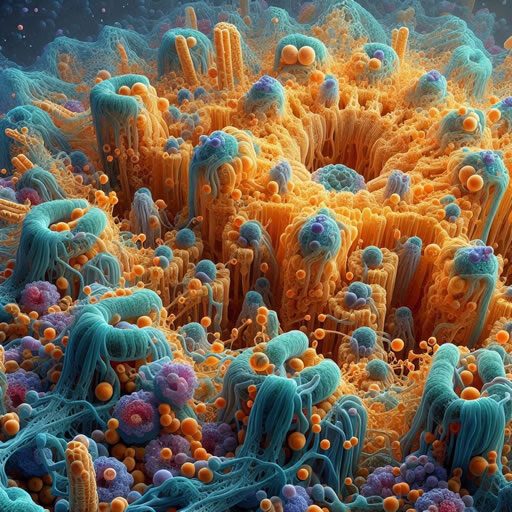
Aquaporins
Water Managers of the Cell
These microscopic hour-glass-shaped tubes control the flow of water in and out of our cells (among many other duties). Without them, cells would not survive.
They are actively involved in brain water balance, cell migration, cell proliferation, neural activity, pain management, epidermal hydration, and the function of the eye and its central visual system.
They are incredibly efficient, transporting billions of water molecules per second.
Aquaporins are not only found in humans, but also provide services for everything from bacteria, to plants, to animals.
Yet this highly complex functionality is said to be separated by a billion years of gradually developing evolution, from plants to the "pinnacle" of evolution, humankind.
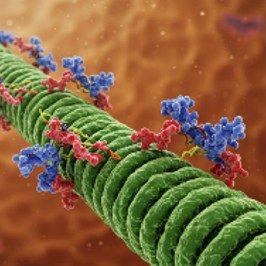
Microtubules
The Cell's Highways
These are sometimes called "the cell's engineering language," and are found in most cells. However, they are formed very differently, and with many more design features, inside the brain's neurons.
They are also known as the "cell's highways." They transfer information millions of times faster than neuron-to-neuron transport. And every neuron in our brains contains many thousands of these (some estimate there could actually be millions of these at any one time that belong to each of our brain's neurons — constructions that are continually being built, destroyed, and rebuilt in a microsecond, on demand!) (A rewarding study, if you are interested in microbiology, is how kinesins and dyneins quite literally "walk" along microtubules to carry out their very complex assigned functions on behalf of the cell that created them — as the above artist's impression illustrates.)
Think of the work that our brain does: For just one hour of thought, the brain calls upon billions of neurons, each orchestrating millions of microtubule "highways" that shimmer with rapid-fire communication. In comparison, astronomical numbers pale — simplistic toys beside the masterpiece of biological computation!
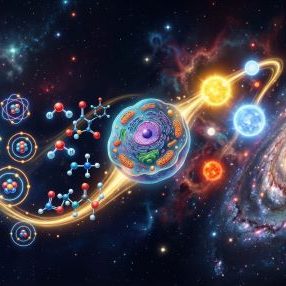
From Atoms to Galaxies
Intrinsic Laws
Imagine the enormous size of a list, a catalogue that encompasses every natural item that exists, from the tiniest ultramicroscopic particles to the sprawling galactic Cosmic Web! Each object in this immense catalogue adheres to intrinsic, immutable “laws” or properties — such as the “laws of physics” and the "laws of nature." These laws — as Scotty famously exclaimed in the original Star Trek TV series, “Captain, I cannot change the laws of physics!” — are independent and inviolable, yet they harmonize together perfectly on every level, creating an exquisite symphonic masterpiece.
Scientists grapple with fully understanding many of these laws, and even more so with explaining their origin.
These laws and properties are sometimes described by evolutionists in this unhelpful way: "They happen to be there, we don't need to ask why." Despite theories that attempt to elucidate the origin of “matter,” no realistic effort has empirically addressed the genesis of these fundamental, critical physical laws.
___________________

Millions of microtubules in our billions of neurons are built, destroyed, and rebuilt in a microsecond, on demand!
If the theory of evolution itself was in the dock, without a doubt the barrister would persist with the question, "Where did these laws originate"?
The Protein Folding Enigma
As remarked above, some protein chains are incredibly complex, with as many as 10 to the power of 300 (10^300) potential folding combinations (see below for a representation of this number.) How might you arrange the correct shape for these monster proteins?
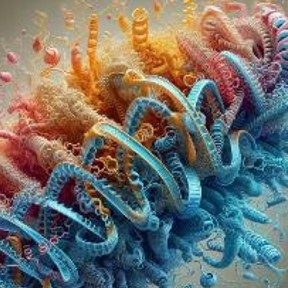
An enthusiastic team of scientists has recently spent many years working on a computer system that, with some ingenious programming, engagement and feedback from the scientific community, a healthy dose of time, effort and good fortune, might be able to reproduce what our bodies manage effortlessly (without our conscious intervention) in microseconds.
Their project, known as AlphaFold, uses "deep learning," an AI system intended to mimic the way the human brain is believed to process information. It was trained on a vast amount of data from known protein structures, with the goal of recognizing patterns and predicting new structures with high accuracy.
This impressive project has many potential benefits that scientists will no doubt endeavour to put into application in time.
However, from the perspective of design, and our current discussion, if the project eventually succeeds in completely solving the complex protein folding problem, what do you suppose this impressive achievement would actually prove?
. . . that high intelligence, an outstanding array of skills, and carefully coordinated planning are required to effectively and successfully design and manufacture fully functioning proteins! — (See Also the article 'The Symphony Before the Composition' on the Home page.)

The popular theoretical physicist Sabine Hossenfelder touches on the complexity of the protein folding problem in this YouTube video.
Scientists, when discussing Albert Einstein's famous equation e=mc^2 say that matter and energy are manifestations of the same thing. Therefore, instead of asking, "Where did the matter come from in the first place?" the real question supporters of evolution should be considering is, "Where did the energy come from?"
Technical Notes (not for technophobes)
The Origin of Fundamental Energy
When an evolutionary scientist is approached with the question: "What is the origin of energy?" they usually refer to what they know of how electrons work or explain at length what they know about the atom.
But this is, to put it pointedly, an evasion of the question.
The enquirer is asking about the ORIGIN of energy, and not HOW it is believed to work!
The "Singularity" is a "Mystery"
When physicists refer to the "big bang" they often place its origin in what they call a "Singularity," which they describe as "an incredibly hot and dense point." In other words, they are suggesting that ALL the matter our immense universe consists of, was compressed to an infinitesimally small point (some say an "infinitely small" point)!
When asked where this hot and dense point came from and how it was even possible, they refer to untestable theory (in contrast with the fact every physics student quickly learns: that energy can be neither created nor destroyed). Scientists (including the late Stephen Hawking) candidly admit that the origin of this "Singularity" is a "mystery." In fact, Professor Hawking, in his book A Brief History of Time (first published in 1988), said regarding this:
"I am now trying to convince other physicists that there was in fact no singularity at the beginning of the universe."
Does the "Multiverse" Theory Solve the Problem?
In view of the difficulties of the "Singularity" theory as touched on above, another popular idea some physicists put forward is the "multiverse" theory. This proposes that matter/energy never really had a "beginning," but was spawned from the death of a previous universe; it also includes the theory that all possible events since the beginning of time have occurred in one or more existing universes! This is not a favourite theory of many physicists. It attempts to avoid the knotty question of 'What is the origin of energy?' by pushing the problem on to a theoretical previous universe! Does that really sound reasonable? Where does this "logical" conclusion end?
Supporters of evolution often say that, given sufficient time, the complexity we see in the universe can eventually come about. Unfortunately, given considerable time, even multiple trillions of attempted universes, the "random" events required for "natural selection" to select, could not possibly produce the order and complexity of the universe and life within it. . . Why not? Because it requires advanced multi-tiered coordinated planning to accomplish what we observe and experience! And — for this view — there is abundant empirical evidence around and within us.
Where Did Life Come From?
Some evolutionists propose that life arrived on earth via a comet or a meteorite from outer space, a theory called panspermia. This hypothesis, however, merely shifts the challenging question of life's origin to the uninviting, radiation-saturated, and chemically unstable environments of deep space. Does this seem plausible to you? Such conditions appear far from conducive to the delicate molecular orchestration required for life to begin. Is the idea of panspermia truly a satisfying answer — or does it simply delay the question by shifting it off-world?
Given the alleged diversity of life across the universe, why have scientists, with their advanced skills, accumulated knowledge, and sophisticated equipment, been unable to replicate the genesis of life? If life could emerge by random circumstances and fortuitous events in the extreme conditions of irradiated space, why can't scientists duplicate this process in the warm, protected, nurturing, and element-rich environment of Earth?
-+-+-+ oOo +-+-+-
"These laws are in evidence on Earth, and everywhere we have thought to look in the universe—from the domain of particle physics to the large scale structure of the universe."
- Astrophysicist Neil deGrasse Tyson
What does the number 10^300 look like? —
1,000,000,000,000,000,000,000,000,000,000,000,000,000,000,000,000,000,000,000,000,000,000,000,000,000,000,000,000,000,000,000,000,000,000,000,000,000,000,000,000,000,000,000,000,000,000,000,000,000,000,000,000,000,000,000,000,000,000,000,000,000,000,000,000,000,000,000,000,000,000,000,000,000,000,000,000,000,000,000,000,000,000,000,000,000,000,000,000,000,000,000,000,000,000,000,000,000,000,000,000,000,000,000,000,000,000,000,000,000,000,000,000,000,000,000,000,000,000,000,000,000,000,000,000,000,000,000,000,000,000,000,000,000,000,000,000,000,000,000,000,000,000,000,000,000,000,000,000,000,000,000,000,000,000,000,000,000,000,000,000,000,000,000,000,000,000,000,000,000,000,000,000,000,000,000,000,000,000,000,000,000,000,000,000,000,000,000,000,000,000,000,000,000,000,000,000,000,000,000,000,000,000,000,000,000,000,000,000,000,000,000,000,000,000,000,000,000,000,000,000,000,000,000,000,000,000,000,000,000,000,000,000,000,000,000,000,000,000,000,000,000,000,000,000,000,000,000,000,000,000,000,000,000,000,000,000,000,000,000,000,000,000,000,000,000,000,000,000,000,000,000,000,000,000,000,000,000,000,000,000,000,000,000,000,000,000,000,000,000,000,000,000,000,000,000,000,000,000
This is the number of possible shape-combinations that some complex proteins can assume once their chain of amino acids has been selected and built. It’s so vast that it dwarfs by many orders of magnitude the estimated number of events that could have occurred since the beginning of the universe!
Even before folding begins, the challenge is even greater mathematically! Consider titin, previously discussed — a colossal protein essential for our body’s muscle elasticity. And, as noted earlier, the odds of assembling its precise amino acid sequence by random selection? …

That’s not a typo. It’s a mathematical shriek. It's a number followed by 44,000 zeroes, representing the possibility of randomly selecting the correct amino acids in the required sequence for this one protein!
Titin is just one of millions — perhaps billions — of distinct protein types our bodies manufacture and maintain; each with its own intricate structure, each vital to the choreography of life. And, notably, more than half of the proteins in the human body are interdependent, their functionalities reliant on each other; a biological reality that flies in the face of the excessive eons of geologic time evolutionists claim for the arrival of complex life, stating “gradual, incremental steps” in the formation of complex organic systems!
Many proteins are similar to titin in terms of complexity, yet all must be assembled swiftly and flawlessly to sustain health, consciousness, and existence itself. What might it look like if we were to compound these odds into a single overall formula?
This is not mere number-crunching. It’s a biological symphony played out in real-time. Could even a supercomputer calculate these odds? Not even if it had somehow continued to run the computations for one protein since the beginning of the cosmos! Could blind evolution, unaided by foresight, have stumbled upon such molecular precision?
To suggest that chaos produces such order is to strain credibility in multiple directions light-years beyond its practical limits! In truth, what we observe is an impossible cascade of improbabilities — each one extreme — layered in neat, ordered succession, from the subatomic to the galactic.
The harmony of the cosmos gestures toward something deeper than the traditional narratives claim:
- A principle of specific order.
- A latent architecture of purpose.
- An intrinsic bias woven into the fabric of the natural laws.