Introduction
Evolutionary theory has shaped modern biology, offering a popular framework for understanding how life adapts and diversifies. Yet as science advances, new questions emerge—questions that involve complexity, coordination, and the remarkable structures found throughout nature. This website and the accompanying book Unmasking the Selfish Gene examine these questions through the lens of empirical science and with a commitment to the pursuit of evidence wherever it leads.
This book explores areas where standard explanations feel incomplete or where new discoveries suggest alternative interpretations. It examines the coherence of physical laws, the architecture of biological systems, and the interdependent mechanisms that sustain life. Far from rejecting established science, it asks whether the traditional narratives capture the full depth of what the empirical data reveals.
For readers who value evidence, clarity, and open enquiry, this website and book offer a thoughtful re‑examination of life's origins. They encourage curiosity, invite dialogue, and propose a unique view of the foundations of reality, of the universe and its origins.
* * * * * * * * * * * * * * *

The Dependency Chains
The successful debut of human life depended on an unimaginably long cascade of prior conditions—a towering hierarchy of interlocking dependencies stretching from the behaviour of minuscule particles to the birth of vast galaxies.
No law or principle in the foundational sciences stands alone in complete isolation; every layer of reality is scaffolded by countless others already functioning in synchrony.
The dependency chain that begins with subatomic particles and rises through atoms, stars, heavy element formation, planetary architecture, and finally the emergence of living systems reveals a universe in which complexity is not a series of fortuitous incidents but a consequence of deep, structured interdependence.
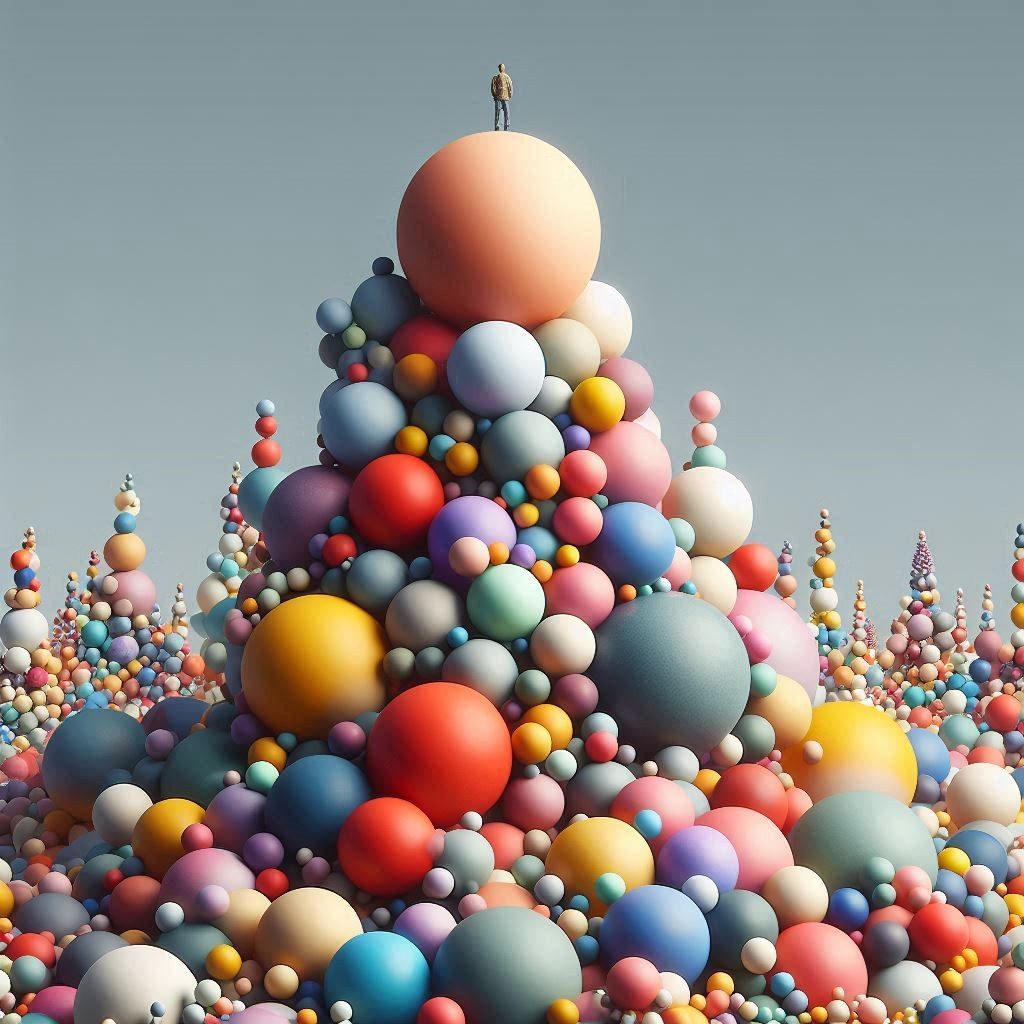
This cosmic lattice mirrors the biological one: just as sexual reproduction requires a densely entangled web of mutually contingent processes (see the article ‘Daddy, where do babies come from?’), the very existence of matter, chemistry, stars, and habitable worlds requires an intricate network of finely balanced prerequisites.
Together, these chains form a comprehensive answer to the enigmatic puzzle explored in Unmasking the Selfish Gene: Life is manifestly not the product of fortuitous isolated events, but the culmination of a vast, coordinated symphony of precise conditions that had to be in place long before biology ever began, and that therefore occurred before any possibility that evolution, mutation, and natural selection could even get started.
A galaxy is only meaningful if stars exist,
- which depend on finely-tuned gravitational collapse within molecular clouds,
- which depend on atoms capable of radiating away heat,
- which depend on stable nuclei forged in earlier generations of stars,
- which depend on protons and neutrons bound in the atomic nucleus,
- which depend on quarks held together by gluons,
- which depend on the strong nuclear force operating at femtometre scales,
- which depends on quantum chromodynamics and the behaviour of gauge bosons,
- which depend on the deeper structure of quantum fields,
- which depend on the fabric of spacetime that allows fields to exist at all.
Atoms depend on electrons bound by electromagnetism,
- which depend on photons mediating the electromagnetic force,
- which depend on charge quantisation,
- which depends on the symmetry structure of the Standard Model,
- which depends on spontaneous symmetry breaking via the Higgs field,
- which depends on vacuum energy and the stability of the early universe.
Stars depend on nuclear fusion,
- which depends on quantum-tunnelling overcoming Coulomb barriers,
- which depends on precise proton masses and charge values,
- which depend on the balance of fundamental constants,
- which depend on the conditions set in the first seconds following the birth of the universe.
Heavy elements depend on supernovae and neutron star mergers,
- which depend on massive stars exhausting their fuel,
- which depend on stellar nucleosynthesis cycles,
- which depend on long term gravitational stability,
- which depends on dark matter scaffolding around galaxies,
- which depends on non baryonic particles interacting only weakly with light,
- which depends on the primordial density fluctuations seeded by the energy of spacetime.
Planets depend on proto-planetary discs,
- which depend on angular momentum conservation during star formation,
- which depends on turbulence and magnetic fields in collapsing clouds,
- which depend on charged particles and plasma behaviour,
- which depend on electromagnetic interactions between particles.
Life depends on planets with stable environments,
- which depend on long lived stars,
- which depend on delicate balances between gravity, pressure, and fusion,
- which depend on the interplay of fundamental forces.
(See also the many additional attributes of our earth, moon, sun and solar system, the fine balances of which are required for the support of comfortable life, in the section 'Planets - Nurseries for Life' on the 'Planning' page.)
Galaxies depend on stars orbiting within dark matter halos,
- which depend on cosmic expansion setting the large scale structure,
- which depends on dark energy (or its “latest” current theoretical equivalent) dominating the universe’s dynamics,
- which depends on the vacuum properties of spacetime itself.
And the cosmic web—the vast architecture of filaments and voids—depends on gravitational amplification of tiny quantum fluctuations,
- which depend on universal expansion stretching microscopic irregularities to cosmic scales,
- which depends on physics operating at energies far beyond current experiments,
- which depends, not only on the existence, but on the fine balances of spacetime, fields, forces, and particles in the first place.