"Borrowed" Systems:
Broken Logic!
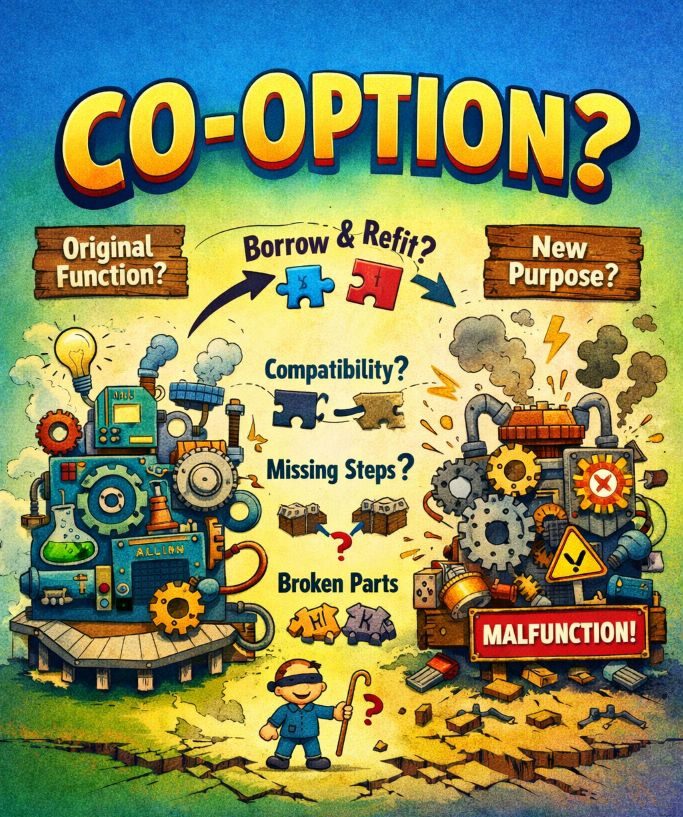

The story of "co-option" assigns the power
of foresight to the theory of evolution!
Evolutionary theory leans heavily on the narrative device called “co‑option” — the idea that complex structures in one organism can be borrowed, repurposed, and refitted for an entirely new role in another. It’s presented as a kind of biological recycling scheme: take an existing system, move it elsewhere, tweak it a little, and voilà — a new organ, behaviour, or biochemical pathway!
But as a plausible explanation, co‑option is astonishingly thin. It asks us to believe that intricate, interdependent systems can be uprooted from one biological context, dropped into another, and somehow remain functional long enough to be transformed into something new. It assumes compatibility where none is demonstrated (either by empirical facts nor by credible theory), foresight where none is allowed, and stability where none should exist.
And this raises the deeper problem: co‑option is not a mechanism — it’s a story. A label. A placeholder that gestures toward an answer while quietly avoiding the engineering realities involved.
So why is co‑option such a weak argument?
The core weaknesses of co‑option, made clear
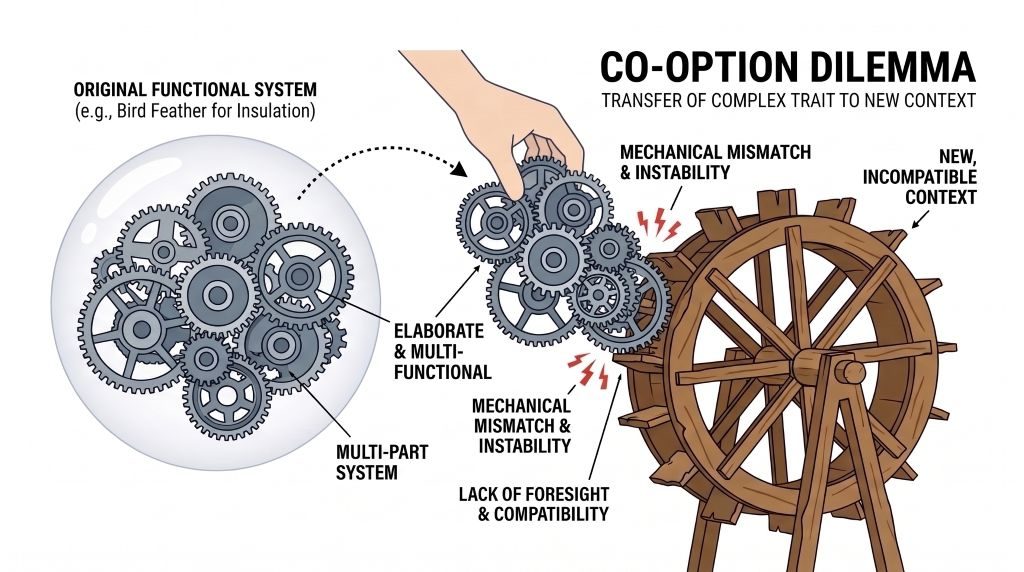
Functional mismatch — Systems evolved for one environment rarely work when transplanted into another. Co‑option assumes they do, without showing how intermediate stages avoid catastrophic failure.
Dependency explosion — Complex features rely on dozens or hundreds of coordinated parts. Moving one part without its network breaks the system. Co‑option hand‑waves this away.
No demonstrated pathway — There are no empirical examples of a multi‑component system being repurposed into a different multi‑component system through unguided steps. The claim is theoretical, not evidential.
Assumed foresight — For co‑option to work, early stages must be preserved long before they become useful. This smuggles in a kind of anticipation that natural selection cannot provide.
Loss before gain — Repurposing a system usually breaks its original function before the new one exists. Co‑option rarely explains how organisms survive this transitional chaos.
Semantic camouflage — Calling something “co‑opted” doesn’t explain how it happened. It simply renames the mystery!
🔥 1. Evolution’s “co‑option” assumes foresight
The evolutionary device of “co‑option” is not an explanation but rather a narrative patch. It assumes that complex, interdependent systems can be borrowed, repurposed, and re‑wired before they function; and all this without foresight, and without breaking the organism in the process. When applied to the origin of sexual reproduction, the problems multiply: co‑option requires a chain of coordinated, mutually dependent innovations that:
(1) cannot be staged,
(2) will not function half‑built, and
(3) are useless in isolation.
X and Y chromosomes are the sex chromosomes that determine an individual's biological sex, with XX typically indicating female and XY indicating male.
The evolutionist’s co‑option claims that a structure originally used for X was later repurposed for Y. But for sexual reproduction, Y is not a “new use” — it is a system-level architecture involving:
- meiosis
- gamete differentiation
- gamete recognition
- recombination machinery
- error‑checking
- cell‑fusion protocols
- mating-type compatibility
- regulatory timing
- DNA repair pathways
- germline sequestration (germline is the population of cells that ultimately become male and female sperm and egg cells)
None of these components can “wait around” for the others. They only make sense as a completed system.
Co‑option therefore smuggles in a hidden assumption: ...that evolution can anticipate future functionality and preserve non-functional intermediates until the whole system is ready.
And this is foresight by another name; or, to borrow a phrase from Juliet in Shakespeare's play Romeo and Juliet, “That which we call a rose, By any other name would smell as sweet.”
🔥 2. Co‑option requires intermediate stages that cannot exist
For co‑option to work, there must be:
- a prior structure,
- with a prior function,
- that can be modified incrementally,
- without losing viability,
- until it becomes an effective function in a new system.
But for sexual reproduction, the intermediates are catastrophic:
- Half‑meiosis is lethal.
- Half‑recombination breaks genomes.
- Half‑gametes cannot fuse.
- Half‑recognition systems cause sterility.
- Half‑mating types collapse population viability.
Co‑option demands a staircase where empirical biology only offers cliffs.
🔥 3. Co‑option ignores the synchronisation problem
Sexual reproduction requires two partners with matching, compatible, simultaneously emerging systems.
Co‑option narratives must therefore explain:
- how both partners co‑opted the same structures,
- - in the same direction,
- - at the same time,
- - with matching molecular interfaces,
- - without any guiding intelligence,
- and without breaking the prior reproductive mode.
This is not a tweak, or an “incremental change.” It is a synchronised overhaul of life’s most fundamental process.
Evolutionary literature rarely addresses this because it is structurally impossible to stage.
🔥 4. Co‑option collapses under the “dependency explosion”
Every co‑option event creates new dependencies:
- If meiosis is co‑opted from mitosis, you must explain recombination.
- If recombination is co‑opted from DNA repair, you must explain gamete formation.
- If gametes are co‑opted from somatic cells, you must explain germline protection.
- If germline protection is co‑opted from stress responses, you must explain mating types.
Each “solution” generates three new problems.
This is why co‑option explanations for sex are always vague, always high‑level, and never mechanistic.
🔥 5. Co‑option assumes that broken systems are tolerated
Co‑option requires long periods where a structure is:
- not doing its original job well,
- not yet doing its new job,
- and is still somehow being preserved by natural selection.
But natural selection eliminates non-functional or harmful intermediates.
Sexual reproduction is especially unforgiving:
Any partial system results in sterility,
and sterility is evolutionary death.
Co‑option therefore contradicts the very mechanism that it relies on!
🔥 6. Co‑option is invoked precisely where evidence is weakest
In evolutionary literature, co‑option appears when:
- no plausible stepwise pathway exists
- no intermediates are known
- no selective advantage can be articulated
- no fossil or molecular evidence supports the transition
It functions as a narrative placeholder, not a demonstrated empirical mechanism.
🔥 7. For the origin of sexual reproduction, co‑option becomes another circular argument
The standard narrative is:
- DNA repair pathways were co‑opted for recombination.
- Recombination was co‑opted for meiosis.
- Meiosis was co‑opted for gamete production.
- Gametes were co‑opted for sexual reproduction.
But each step requires the next step to make sense.
It is a staircase that is built from its own roof!
🔥 8. Co‑option cannot explain the arrival of purpose in the system
Sexual reproduction introduces:
- long-term lineage strategy
- genetic mixing
- future (population-level) benefits
- delayed individual payoff
- increased metabolic cost
- reduced reproductive speed
These are not “borrowed functions.”
They are systemic goals!
Co‑option cannot generate goal‑directed architecture without smuggling in foresight.
“…if there is one event in the whole evolutionary sequence at which my own mind lets my awe still overcome my instinct to analyse, and where I might concede that there may be a difficulty in seeing a Darwinian gradualism hold sway throughout almost all, it is this event — the initiation of meiosis.”
— W. D. Hamilton, evolutionary biologist (1999)
In the end, meiosis (the special cell‑splitting process that turns a newly fertilised cell into sex cells with half the usual DNA, so that offspring get half from each parent) stands as one of evolution’s most unyielding riddles: a breathtakingly choreographed, multi‑stage process that must function flawlessly from its very first appearance or it collapses into sterility — and sterility is evolutionary extinction.
The precision timing of the process, its bespoke molecular machinery, dual‑division logic, specific algorithms, and its requirement for two fully compatible sexes all have to be present together, not piecemeal, for the system to work at all! This is why even leading evolutionary theorists concede that no gradual, mutation‑by‑mutation pathway has yet even been plausibly theorised, let alone revealed in the fossil record.
Meiosis is not merely another biological feature awaiting explanation; it is a towering conundrum whose interlocking complexity resists the very incrementalism on which Darwinian evolution depends for its own survival!
(See also the paper dealing with other evolutionary "vehicles" : A Treatise on Evolutionary Protein-Developmental Vehicles)