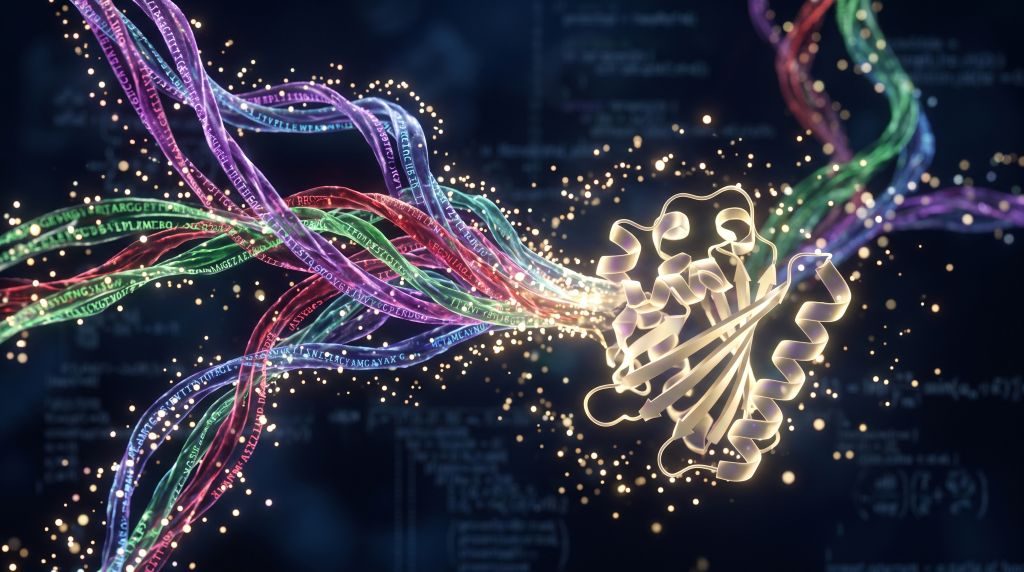
THE SYMPHONY BEFORE THE COMPOSITION
🟣 Our cells routinely manufacture over 400,000 protein types, each a specialised molecular tool.
🟣 Each protein type has a fixed design, a specific and unique assignment, and finds a critical place in the machinery of the cell.
🟣 The composite protein library satisfies each of these thousands of tasks; none are absent, none are redundant, none are optional.
🟣 But how did this come about? How can evolution “read” this library? It does not keep a catalogue, nor an index of required tasks—raising the question: How did evolution “determine” all the tools needed?
Life's origin story is usually told as a gentle beginning: a peaceful earth, a warm pond, a random spark. The tale then expands into a gradual blossoming — chemistry turning to biology, and simplicity eventually flowering into the astonishing diversity we see today.
But zooming in on just one thread of that tapestry — the rise of proteins, the molecular workhorses inside our cells — the story shifts dramatically. The odds of the original designs for these proteins appearing without direction or planning aren't merely slim; they collapse into insignificance, vanishing into multiple probabilities so tiny they individually defy comprehension — and yet, each protein is only of value when it works in a mutual microscopic dance with other proteins and cellular players!
Once the true scale and the implications of this enigma are fully perceived, the familiar tale of life's accidental arrival begins to look less like science and more like a myth that is told to avoid confronting the true depth of the mystery!
But it is not really the numbers that are under consideration here!
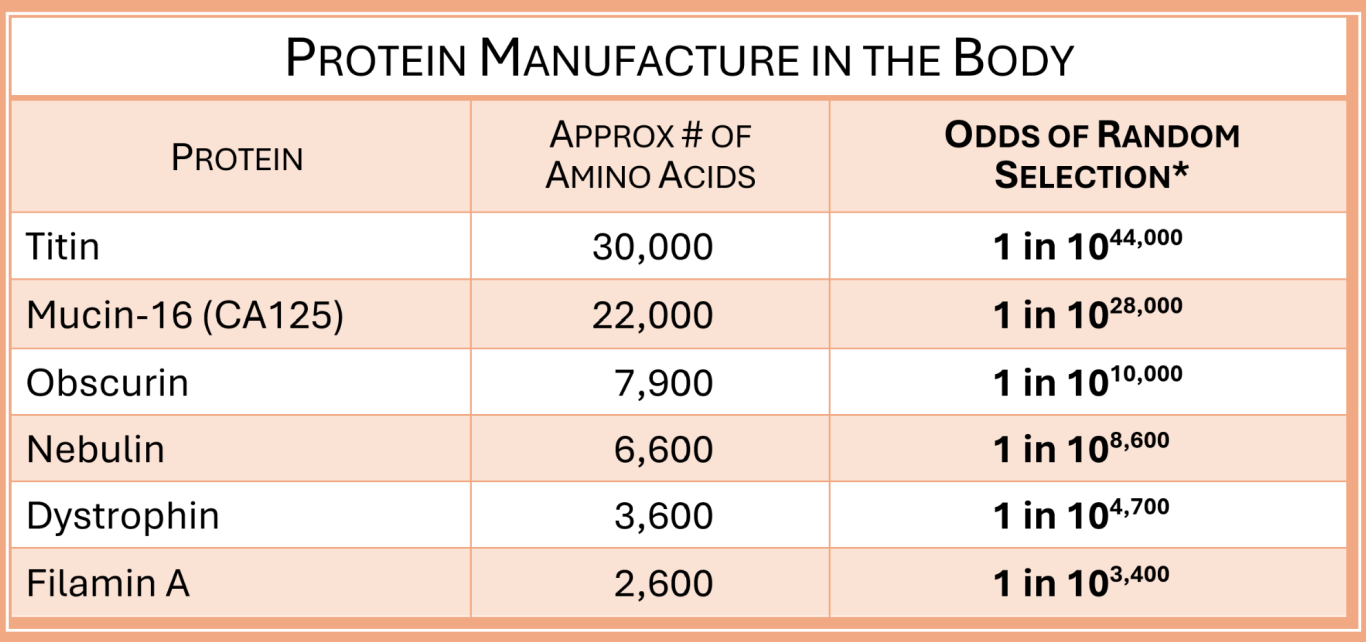
*[Technical Note A:] The odds listed here concern the amino acid sequences, that each of our proteins consist of, as encoded in each cell's DNA. The chart takes a simplistic view and regards each one as a single linear chain. Inside each human cell, the organic “machinery” that selects and links amino acids into a growing polypeptide chain does not operate by random selection for each amino acid — it follows instructions, already embedded in the DNA, which specify the next amino acid that is added at each step; and this is performed with the assistance of cellular machinery. This is not what the odds in the chart are based on, because the cell’s translation system relies on information that is already present.
The improbabilities in the above table arise, therefore, not from this routine device-assisted action of building proteins, but from the specifications for the original amino acid sequences, as well as the instructional coding for the building of the accompanying specialised cell machinery, that were written into the DNA in the first place for each of the critical protein types that are collectively employed by the cell. — (For additional technical info, see our science paper; and for a discussion on the biological “vehicles” used by evolutionists that endeavour to account for the arrival of proteins and mitigate the random factor, see the technical articles 'A Treatise on Evolutionary Protein-Developmental Vehicles' and '"Borrowed" Systems: Broken Logic!')
These facts lead to the following $64,000 questions that challenge the traditional view:
- By what means did the chemistry of the cell write the instructions into the genome originally?
- Using the evolutionary model, would the cell have also encoded each unsuccessful (attempted) amino acid sequence?
- Even if it did, how could this have worked successfully?
- But how and when were the workable successful sequences written into the permanent record of DNA to seal the mould for the manufacture of all future proteins of each standard type?
A Practical Impossibility!
Each of the odds in this chart towers so far beyond the realm of plausibility that they render the notion of human life arising by undirected events not just highly improbable, but mathematically absurd, and in practical terms impossible.
*[Technical Note B:] Critics of this type of numbers-based argumentation often respond that extreme improbability is not the same as impossibility, and try to dismiss such calculations as irrelevant to their theory. However, a comprehensive review of the points raised in this article reveals that these odds, in this empirical context, cannot be so easily dismissed!
A common counter‑argument used by evolutionists is that the emergence of the original method for the manufacture of functional proteins did not occur via random events, but unfolded through “natural,” “holistic” chemical pathways that supposedly could not have produced any arrangement other than the one we observe! However, this defence presupposes the very mechanisms under debate. Evolutionary explanations of protein formation typically appeal to the cellular machinery that interprets, assembles, and regulates protein manufacture — machinery that is built using instructional code that was also originally written into DNA.
This is the crucial point: The improbabilities presented in the ‘Protein Manufacture in the Body’ table above do not just concern the formation of individual proteins. They encompass the origin of the specialised coding system, translation apparatus, and regulatory architecture required to design and construct the protein manufacturing process itself; a process that had to be already fully functional in order to build these proteins in the first place. Any argument that invokes existing biological machinery to explain the emergence of that very machinery exhibits circularity, a Catch-22 situation. (See the article 'The Potent Paradox' for further examples of circular reasoning.) The following question therefore requires careful thought:
How did the essential system that is required to produce these proteins work successfully before the system itself existed?
The traditional narrative says: “By means of incremental changes”; ... … Really?
Where Supercomputers Do Not Begin to Compare!
Consider the argumentation for random selection for a moment as illustrated in the above chart: even the tiny subset of six of the proteins that our bodies assemble continuously, presents a combination of odds so vast that they dwarf astronomical numbers by multiple orders of magnitude!
To merely count through any one of the numbers in the chart to completion, even a modern supercomputer would require considerably more time than the age of the universe — in fact, that same length many times over! These values don’t just challenge our intuition; they defy the very limits of practical considerations. And yet in a way our cells deal with these numbers with consummate ease!
Moreover, the chart lists just six protein types. Exceptionally high improbabilities must also succeed across each of the other unlisted protein types (estimated to number somewhere between 80,000 and 400,000, with biologists suggesting it could in fact reach a million types — see https://biologyinsights.com/how-many-human-proteins-are-there/) that our bodies assemble with ease and with consistent success.
As an example, among the smallest of our proteins is insulin, consisting of *only* 51 amino acids. The odds of randomly selecting this relatively small sequence as a single linear chain are 1 in 2.6 × 10⁶⁶ — odds that make the above card-shuffling example trivial by comparison! If, as evolutionists propose, a physical process facilitated these selections that became indelibly encoded in DNA, then it must be asked: How was this facilitating process itself developed and constructed?
If a rational intelligent enquirer is to be adequately convinced that gradual incremental changes could account for these original designs, then either all of these staggering improbabilities, for every protein type, must have occurred fortuitously and simultaneously, or the arrival of the initial design-generating mechanisms for all protein types has been experimentally demonstrated—not by conjecture or narrative, but by empirical science!
Note that missing even one of these protein types would result in serious consequences for us, ranging from diminished quality of life to the impossibility of our lives being sustained at all! (See the chart of examples in the science paper under the heading 'Cellular Interdependence and Orchestration'.) In this way, the above “odds” are compounded exponentially.
And, again, note that we are here discussing the original development of the mechanism for building each protein type and its associated biological “machinery,” not the routine assembly of individual proteins that evolutionists refer to in response!
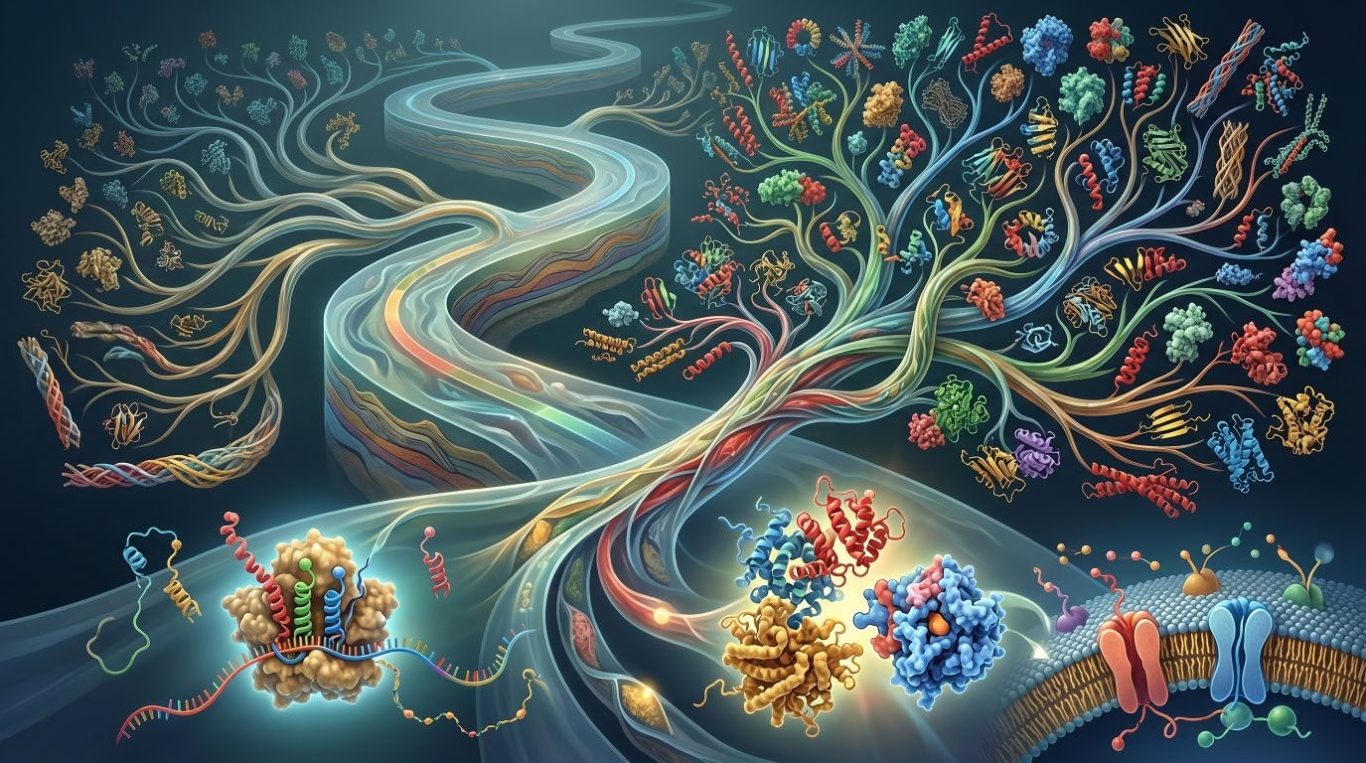
Gradual evolutionary development over geological time ? . . .
The proposed eons of time would prevent the coordinated actions of proteins,
as they must operate in concert, and cannot be assembled in geological slow‑motion!
The development of the original protein manufacturing system within the cell is not just a case of dealing with compounded extreme improbabilities, but also detailed, complex order and specific arrangement applied to many layers of connected functionality.
The vast geological timescales invoked by evolutionary theory offer no refuge here inasmuch as, not only would missing a single protein type be critical for us, but far too many of our proteins are interdependent, mutually reliant, and therefore must function simultaneously within the cell to be of any value to the body.
The eons of time proposed in the evolutionary narratives would not enable these proteins to fulfil their respective tasks in concert: The development of each of these protein types must be completed at the same time! (For a technical view, see the science paper under the heading 'Cellular Interdependence and Orchestration'.)
Even if it is assumed that multiple “successive, slight modifications” (as Darwin put it in Origin of Species) could somehow accomplish this detailed choreography (and overcome the additional hurdles covered in this article), the vast evolutionary ages claimed would still prove to be insufficient for even a fractional success!
A Walk Around the Galaxy!
But the above extraordinary odds are in fact a walk in the park compared to what happens next!
Successful amino acid sequence selection is overshadowed by the complexity of three-dimensional folding. Proteins do not remain as linear strings, but each one must be folded into a unique 3D shape before it can begin its assigned tasks within the cell.
Consider this: It's estimated that our sun takes around 250 million years to orbit the centre of the Milky Way. This means it has only had 20 galactic years in its lifetime! In reality, the appeal to immense geological timescales does not help the evolutionary narratives, as there is insufficient time for undirected events to successfully produce the target designs for protein types (and this includes the assumption that evolution also somehow anticipates this target functionality).

Artist's impression of the protein Titin — a single molecule!
In summary: Protein manufacture is a two-stage process:
(a) linking the correct sequence of amino acids into a linear chain (a task that takes our cells mere seconds); then,
(b) folding this chain into a specific shape; a process that our cells perform in zero seconds.
The second stage, Part B, is so complex that the AlphaFold project — an international collaboration of many scientists (now more than two million strong) along with a team of computer programmers — has spent years calculating how to theoretically achieve what the cell actually achieves instantaneously, quintillions of times per second in our many cells! (Note: the yet more intricate Part C is outlined later!)
Protein Development Required a Chorus, Not a Solo
Evolutionary theory holds that biological complexity emerged gradually, through “numerous, successive, slight modifications” accumulated over immense spans of time. Yet if the earliest amino‑acid chains were produced without guidance, a troubling question arises: On what grounds would natural selection favour a redundant, non‑functional string of useless residues? Until a precise and decidedly specific folding mechanism existed, these linear chains had no biological value; they were inert materials awaiting a transformation that had not yet been invented!
To claim that evolution slowly assembled the machinery for protein synthesis only intensifies the puzzle. And extending the timescales in the narratives even further only makes this puzzle harder to solve! Without the completed architecture for correct folding already in place, the organism would generate nothing more than mis‑sequenced, non‑functional strings — structures offering no advantage and therefore no reason to be “selected” at all!
As an example, consider a factory that manufactures sophisticated vehicles gathering millions of components to build an intricate spacecraft, but with an awkward catch: the engineers are not aware of the function that each finished part will ultimately fulfil on behalf of the completed craft!
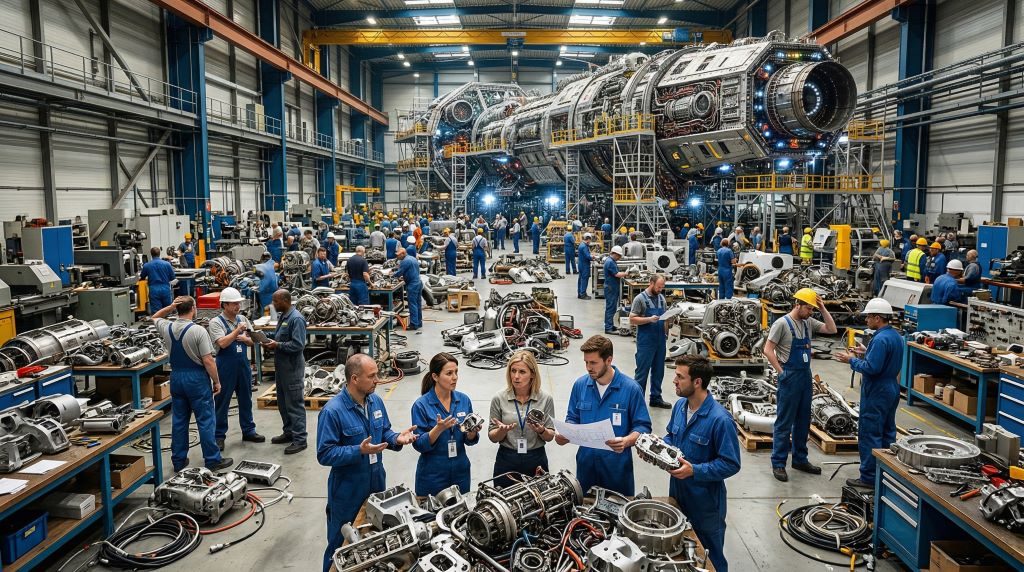
Every "step" involved in the process
must be in place simultaneously
for the production to succeed!
No Feedback Mechanism = No Proteins
The above considerations lead us to additional pointed questions: Why do our bodies no longer make protein re-configuration attempts? Is it not because each protein our cells produce is a finished product and belongs to the catalogue of standardised protein designs? But how could a blind process determine the nature of a “finished product”? How did evolution arrive at the correct formation for each of these protein types; i.e. during the eons of “gradual evolution,” and the many unsuccessful attempts at the original protein design, how could it be ascertained that success had finally been achieved for each construction, each protein type?
By what feedback mechanism did successful construction seal the established design of each of these components, so that further configuration changes (“numerous, successive, slight modifications”) were no longer made? The alternative is for evolution to possess knowledge; to somehow “know” the precise amino acid sequence followed by the particular folding mechanism in order to adequately fulfil each protein type's target function! But how can a blind process “know” anything? Could evolution somehow anticipate the required function for each protein? This is clearly not the case!
And, again, note that we are here discussing the original development of the mechanism for building each protein type, not the routine assembly of individual proteins that evolutionary narratives return to!
Solving the dual challenge of assembling the correct amino‑acid sequence and guiding it into its precise three‑dimensional form is already a triumph of biological engineering. But the deeper mystery, Part C of the process, lies beyond: How were these complex, fully operational procedures converted into enduring consummated genetic instructions, enabling DNA to deploy them universally? How were these instructions composed, standardised, and permanently inscribed in the DNA as a chemical code, allowing every cell to employ them consistently?
A Profound Puzzle at Evolution's Core
Let us take a detour for a few moments to investigate, in practical terms, the implications lurking within the standard evolutionary narratives:
If the original development really was random, we are left to envision the tireless reconfiguration of proteins until, by trial and error, a viable structure materialises. (Note that the evolutionary "vehicles" used to explain "order from randomness" are dealt with in this article.) But ponder for a moment on this: What is it that prompts these repeated attempts to be made at all? What cellular mechanism would drive the generation of multiple alternative amino-acid-chains without the foresight to determine that a successful functional outcome was available to reward these considerable efforts? The theory posits that countless non-viable sequences must have arisen; each a biochemical cul-de-sac, discarded in the march toward success.
Did evolution “know” that a potential, functional novel protein type lay undiscovered, that would be vital to the cell’s functionality? Was there, on some level, an awareness of the *need* for a protein of a specific design? Evolutionary theorists would surely not contemplate such a possibility (evolution has no such “awareness”)! As the bullet point at the beginning of this article put it: Evolution keeps no catalogue, no index of required tasks — raising the question: how did it “determine” the tools needed?
If there is no planned choreography behind protein construction, we’re left with randomness as the only available architect. But that raises an awkward question: What happened to the vast ocean of failed amino‑acid chains produced along the way? Were they all dutifully assembled, folded, tested, and then discarded one by one, like an endless queue of doomed prototypes? Are we to imagine early cells tirelessly experimenting with random sequences because they somehow “expected” that a functional protein would eventually appear? Even if such a scenario could be conceived, and even if the moment of success actually arrived, would a protein that is merely useful be enough?
Biology teaches a sharper truth: every protein type in our cells performs a unique, indispensable task — and yet there are no superfluous passengers in the molecular workforce.
The clear message therefore is this:
There is no room for random trials!
Take titin discussed earlier, the colossal muscle protein consisting of more than 30,000 amino acids (in its longest human isoform). The explosion of possibilities for such a sequence — around the order of one chance in 10^44,000 — dwarfs even multiple cosmic scales, implying an untenable cascade of failed trials that would swamp cells with an unmanageable quantity of dysfunctional debris. And this is just one protein type!
Does this practical depiction of evolutionary protein development origins — an unrelenting torrent of random sequences, fruitless experiments, and molecular waste — genuinely square with the genesis of our body's intricate and comprehensive collection of protein types? Or does it expose a profound puzzle at evolution's core, where the compounded improbabilities and lack of awareness of functional requirements strain credulity beyond its limits?
(And please note again: For a discussion on the biological “vehicles” used by evolutionists to try and mitigate the random factor, see the technical article 'A Treatise on Evolutionary Protein-Developmental Vehicles'.)

Could this factory succeed if the engineers had no idea what
each component's function was going to be after completion?
DNA has no chemical testing equipment nor any feedback mechanisms; it's a thorough, consummated information repository; the genome is not an architect, it's an archive; and evolution is not a designer — it does not aim, foresee, plan, or purpose!
The conceptual image above offers only a crude echo of a human cell’s complexity. Each cell, in turn, is just one contributor among the trillions that collaborate to form a single human body. In this chapter we have focused solely on proteins — yet proteins represent only one class of actors in a cellular drama crowded with specialised performers, each executing its own indispensable role in the choreography of life.
Within the cell, an entire molecular metropolis hums with purpose: enzymes catalysing reactions at breakneck speed; histones coiling and organising the genome; ribosomes printing proteins with atomic precision; endosomes shuttling cargo; chromatin dynamically opening and closing; lysosomes digesting waste; peroxisomes detoxifying; proteasomes policing damaged proteins; centrosomes and centrioles orchestrating division; vacuoles storing resources; microvilli, cilia, and flagella shaping movement and sensing. Even this catalogue is incomplete — microbiology continues to uncover new structures, new assemblies, and new layers of organisation that deepen our appreciation of life’s staggering intricacy.
Thus the caption for the image above could be reframed:
Could life’s spontaneous rise succeed if evolution designed proteins without having any insight into the role each one would ultimately play in the finished cellular symphony?
Perhaps it is little wonder that the late Dr. George Wald, Harvard University biologist and winner of the 1967 Nobel prize in physiology, lamented:
“I choose to believe in that which I know is scientifically impossible; spontaneous generation.”
And the late Richard Lewontin, professor of genetics and a “central figure in evolutionary biology,” also lamented:
"We take the side of science in spite of the patent absurdity of some of its constructs, in spite of its failure to fulfill many of its extravagant promises of health and life, in spite of the tolerance of the scientific community for unsubstantiated just-so stories, because we have a prior commitment, a commitment to materialism.”
Do these comments really constitute genuine, enquiring, probative science? “Materialism” is “the belief that everything consists of and is made of only physical stuff — atoms, molecules, etc.” Yet, is it not true that most scientists believe in the existence of Dark Matter and Dark Energy (or the latest “current” theory for these), entities that are neither fully understood nor adequately explained as yet, inasmuch as their “physical nature is unknown”?
So these entities are definitely there, but they are not yet understood! Does this lack of understanding dampen the desire for enquiry?
In summary: The cell is not just complex, it is also coherent — a system whose unity defies reduction, whose parts do not merely coexist but function harmoniously. It is not a random collection of fortuitous mechanisms, but a choreography of essential interactive functions that serve an overall purpose: the maintenance of the conscious life to which each cell belongs!
As discussed earlier, all proteins perform a vital specific function for the cell, and yet there are no proteins whose functionality is superfluous to it! Does evolution somehow maintain a catalogue of the functional requirements that each protein type fulfils?
In the end, proteins stand before us as a complete set of fully-formed performers in life’s orchestra — each essential, none redundant. The seamless integration of these molecules into cellular life demonstrates a choreography that precedes the orchestral symphony score (the DNA code), urging rational enquirers to rethink the adequacy of conventional evolutionary accounts. The impossible odds and the associated empirical facts included in this article, fly in the face of the postulate that life arrived by the undirected events described in the orthodox chronicles!

And finally, the above considerations are merely a drop-in-the-ocean of improbabilities that can be found in the cosmos, the solar system, the earth, and the biology of life.
To accept the traditional narratives in the face of such layered interdependent detailed complexity, is to stretch plausibility in multiple directions light-years beyond the boundaries of reasonable inference!
(If you are a student in the field of biology or cosmology or another branch of life sciences or physics,
you may wish to review our paper which serves as the scientific basis for this article.)