☕ The 2-minute Infusion — to be Served With Morning Coffee
🦋 The Moth: A Nocturnal Engineer of Elegance
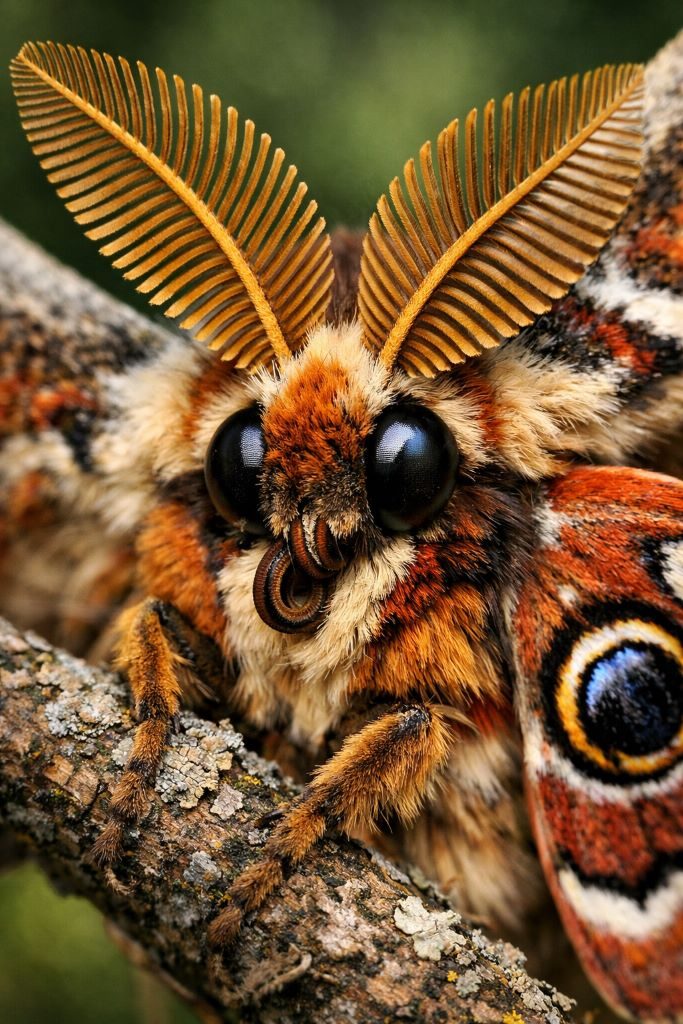
“Insects drum, frogs chorus, bats whisper in ultrasound. The animal kingdom is a vast orchestra, each species tuned to its own frequency.”
— Bernie Krause, American soundscape ecologist.

“An intellectual contortion —
an insistence that complexity
is its own cause.”
Often overshadowed by butterflies, moths are a treasure trove of design features that defy their drab reputation. They're not merely dusty wings and pantry pests — they're fascinating enigmas with astonishing capabilities.
The moth is not just a creature of the night; it is a curator of darkness. While the day belongs to the flamboyant and the phototropic, the night is a domain of more subtle wisdom — those who navigate by absence, who manage their lives in gradients of shadow, who treat silence as a medium and vibrations as a map.
In the brief tremor of a moth's wings, the universe reveals how beauty can be engineered to amaze without ever raising its voice.
- Its wings are manuscripts of micro‑architecture.
- Its flight is a negotiation of turbulence management.
- Its senses are tuned to frequencies that human intuition rarely visits.
- The moth is not a primitive butterfly;
- It is a nocturnal engineer of elegance.
🧭 Pheromone Communication
Moths communicate over vast distances using pheromones. Males can detect a single molecule of a female's scent from kilometres away, guided by antennae that rival satellite dishes for their sensitivity.
🌌 Night-time Pollinators
While bees sleep, moths pollinate nocturnal flowers with remarkable efficiency. Their fuzzy bodies trap pollen, and their long proboscises reach deep into floral structures inaccessible to other insects.
🧬 Metamorphic Mastery
Some species remain underground as caterpillars for years, emerging for a single day of flight and reproduction. This delayed emergence is synchronised with environmental cues — an elegant example of biological timing and intricate design foresight.
Of course, the proposal of evolution's “survival of the fittest” motif begs the question: How could this long-term mechanism arise in harmony with the evolutionary narratives? Does evolution somehow plan with the future in mind? The following study will offer some interesting answers to these questions.
🔊 Sonic Defence System
Bats are the principal predators of moths. However, some moths, for example the tiger moth, can detect bat echolocation and respond by emitting ultrasonic clicks of a specific frequency. These clicks jam the bat's sonar or signal toxicity, allowing the moth to evade predation mid-flight.
The tiger moth, in particular, has been drafted into a curious evolutionary story: that it “evolved” this sonar‑jamming defence. The story is told with the breezy confidence of a bedtime tale:
- Bats hunted moths.
- Moths “developed” a countermeasure.
- Natural selection favoured the moths that jammed the signal.
- And thus, over time, a sophisticated acoustic defence system emerged.
Elegant in its simplicity! But this narrative collapses under its own weight when we examine its internal logic.
For the moth to “evolve” its own sonar jammer, it would need to:
- Comprehend that the sound it hears has been emitted by a predator bat.
- Identify the bat's ultrasonic signal — a signal it had never previously interpreted.
- Understand the functional purpose of that signal — predation, not courtship, not navigation, not superfluous.
- Intelligently infer a counter‑strategy — that emitting its own ultrasonic pulses could successfully confuse the bat's echolocation.
- Re‑engineer its own anatomy — somehow constructing a new body organ capable of producing precisely modulated ultrasonic clicks.
- Encode the details of this innovation genetically — writing a durable instruction set into its own DNA for perpetual inheritance.
This is not “adaptation.”
This is systems engineering.
This is not “random mutation.”
This is acoustic counter‑intelligence.
This is not “selection pressure.”
This is an example of functional, purposed technology.
But evolution knows nothing of planning and purpose! To claim that such a defence “simply evolved” is to mistake a symphony for a sneeze!
The Moth as an Information‑Bearing Creature
The moth is not a passive recipient of environmental conditions and forces.
- Its antennae are not decorative filaments; they are chemical observatories.
- Its wings are not mere surfaces; they are aerodynamic algorithms.
- Its nervous system is not a bundle of wires; it is a distributed decision‑making network.
When the tiger moth emits its ultrasonic clicks, it is not performing a reflex. It is executing a complex protocol.
- The bat sends a signal.
- The moth replies with a calibrated sound.
- The bat's echo collapses.
- The moth escapes.
To reduce this behavioural orchestration to “mutation and selection” is like reducing a chess match between grandmasters to the movements of pieces of wood.
The Problem with Undirected Evolutionary Engineering
The standard evolutionary narrative asks us to believe that:
- A creature with no concept of sound,
- With no capacity to foresee the future,
- With no mechanism for specific anatomical redesign . . .
- . . . Somehow engineered a broadband acoustic jammer,
- And then wrote the coded blueprint of its design into its own genome,
- Without being able to test the results of its new DNA code!
This is not science.
This is mythology wearing a lab coat.
The heart of the problem is the insistence that evolution is blind, mindless, mechanistic, yet somehow produces technologies that rival and even surpass human ingenuity!
- If a human engineer produced an equivalent mechanical sonar‑jamming device, their intelligence and creativity would be a cause for commendation and praise.
- If a moth manufactures one, we are expected to believe it was an accident “selected” by nature.
- The moth deserves better than this intellectual exercise in storytelling!
🧩 Conclusion: The Improbable Precision of Life
When confronted with the layered intricacy of biological systems — from the electron transport chain system to the sonar-jamming clicks of the tiger moth — one is compelled to ask whether such orchestration could plausibly arise from a blind sequence of incremental tweaks over geological time, as Darwin claimed. These are not mere assemblages of parts but symphonies of function, coordination, and foresight.
The notion that systems like these emerged through mutation and selection, without a blueprint or a sense of purpose, begins to resemble an intellectual contortion — an insistence that complexity is its own cause (see the article 'The Potent Paradox'). The evolutionary narratives — in light of the extraordinary precision, interdependence, and elegance of these designs — strain credulity.
To attribute these features to undirected events is not just unlikely — it's a major category error. These are not accidents of nature that occur with a random deal of the cards; they are designs that favour intentional order and specified arrangement.
- This is not “adaptation.”
- This is systems engineering.