☕ 2-minute Taster — to be Served with Morning Coffee
🧭 Sailors of the Invisible Sea: Animal Magnetism!
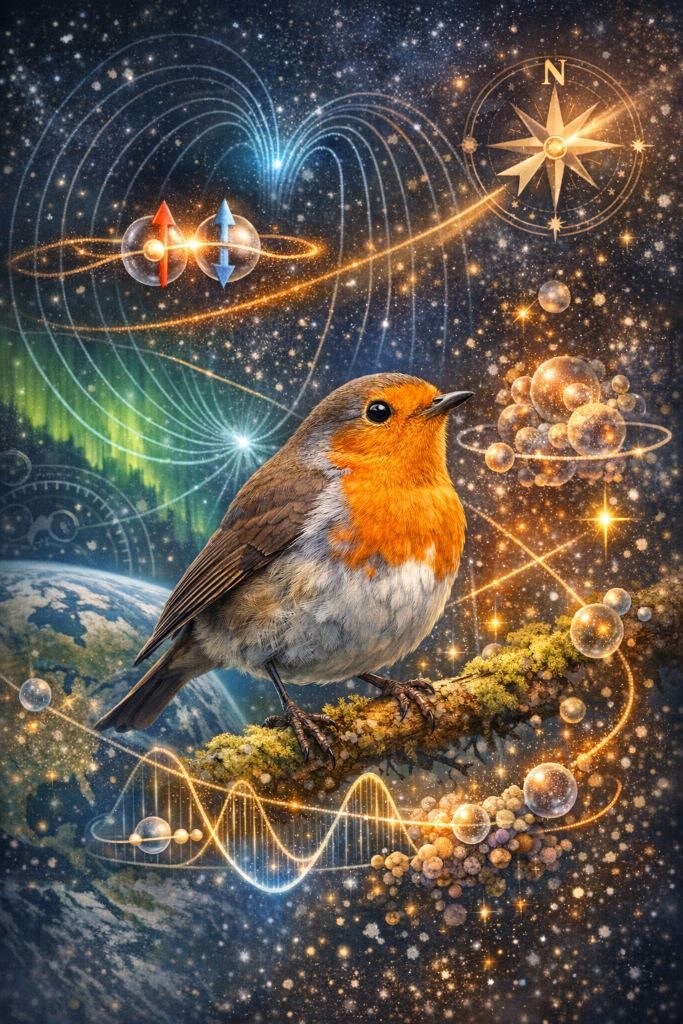
“Despite more than 50 years of research into magnetoreception in birds, scientists have been unable to work out exactly how they use this information to stay on course.”
— Peter J. Hore and Henrik Mouritsen, quantum physicist and neuroecologist.

Did the robin somehow grasp the principles
of quantum entanglement, electron “spin”
and molecular resonance, and actually
rewire its own anatomy?
Some creatures possess an astonishing ability: they can detect the earth's magnetic field and use it to navigate across vast distances with astonishing precision.
This phenomenon, known as magnetoreception, is not limited to birds — it is manifest in a curious menagerie that is found throughout the limbs of Darwin's Tree of Life! It includes sea turtles, salmon, bees, bats, ants, and even cows.
Bio-navigation is not the exclusive domain of mammals and creatures of the land and sea; it also belongs to lowly plant life. When a seed is planted deep in the soil, upon sprouting it needs to reach out for the sunshine with its leaves but with its roots for the deeper soil to acquire essential nutrition. How does it “know” which direction to grow? It does this using multiple techniques:
- A process called geotaxis helps the plant to determine which way is up;
- protoplasm within the seed exerts pressure on the bottom, influencing orientation;
- starch grains settle at the base of the cells, giving further guidance to orientation;
- the hormone auxin accumulates in the lower section to help detect the orientation of the force of gravity; and
- gravity-sensing cells such as statoliths produce signals that “teach” other cells which direction to grow!
The question must be asked: How did evolution develop and coordinate these multiple techniques to help plants reach out for the vital sunlight that would enable them to thrive, and to provide food for animal life?
Among the creatures that have been subjected to significant study in the field of navigation is the European robin (Erithacus rubecula) — a diminutive songbird whose migratory feats defy simplistic explanations. Without any conscious grasp or comprehension of quantum mechanics and biochemistry, this tiny robin nonetheless “uses” principles of advanced science to return unerringly to its ancestral home. It is, in effect, a quantum navigator in feathers.
Recent research suggests that the robin's magnetic sense may arise from a light-sensitive protein called cryptochrome, located in the retina of the eye. This protein appears to exploit what is called the radical pair mechanism, a quantum process involving “electron spin states” that are exquisitely sensitive to magnetic fields. In essence, the robin's eye functions as a quantum compass, tuned to the geomagnetic whispers of the planet.
But this leads us to the $64,000 questions that pierce to the heart of the evolutionary narrative:
- Did the robin itself engineer this accomplishment?
- Did it grasp the principles of quantum entanglement, electron “spin” and molecular resonance?
- Did it then rewire its own anatomy, recompose its biochemistry, and program its own neural architecture to make use of these invisible cues?
- Finally, did it follow up these achievements by adding the molecular instruction code into its own genome to benefit future offspring?
The robin is not a physicist, neither is it a chemist or a designer. And yet it performs as if it were all three.
This paradox — of subconscious precision — invites deeper reflection. Evolutionary biology offers mechanisms: mutation, selection, adaptation. But it does not offer intention. The robin did not choose to become a quantum navigator; it simply is one from birth, just like the humble spider that is not taught to spin geometrically impressive webs, it also does this right from birth!
So the evolutionary narrative is left with a mystery: how does nature, blind to theory and purpose, stumble upon complex and elaborate systems that manifest both of these? How does a creature without knowledge of physics come to embody some of its most mysterious principles?
Perhaps the robin is not the engineer, but the expression of an engineering process — one that unfolds with apparent foresight and yields teleological results… A process that, in its silence, speaks volumes! — (See also the article 'The Symphony Before the Score' and consider the odds of these amazing proteins arising by undirected means.)
And, for those who believe this intricate engineering arose as a result of random events, remember:
- Humans could barely survive without bees!
- Bees could not locate nectar without the mechanics of impressive navigation techniques! — (See the article 'The Secret Choreography of Bees: The Riddle of the Wriggle' available in the book.)
(If you have struggled to understand any of the science in this article, think how the poor robin feels!)
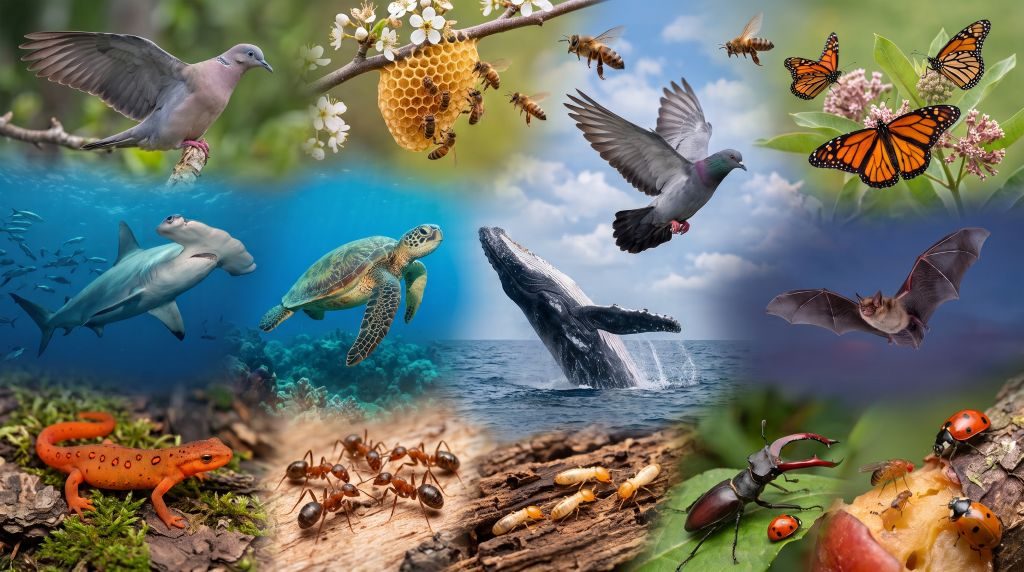
Did multiple creatures really independently discover
and manufacture their own navigation techniques?
