

SUNDAY
26 July 2026
Challenging the story the world believes without question.
🦋 The Chrysalis Paradox: According to Plan
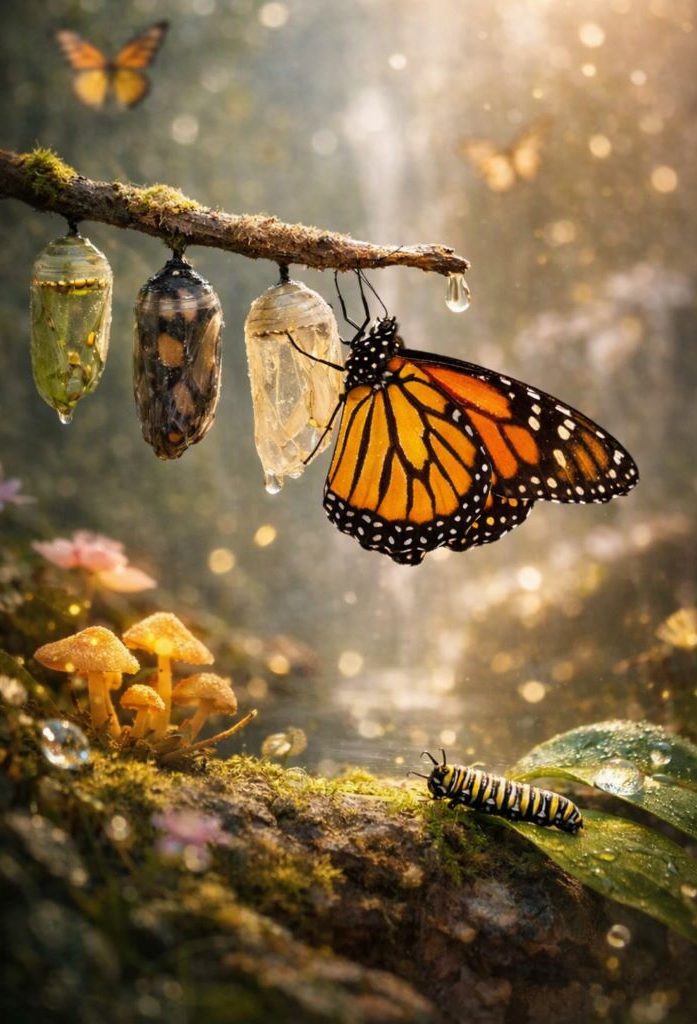
“When the marvelous butterfly takes wing, nothing of the caterpillar remains.”
— Alejandro Jodorowsky, artist and filmmaker.
The caterpillar contains the
blueprint for a creature
that it will never become!
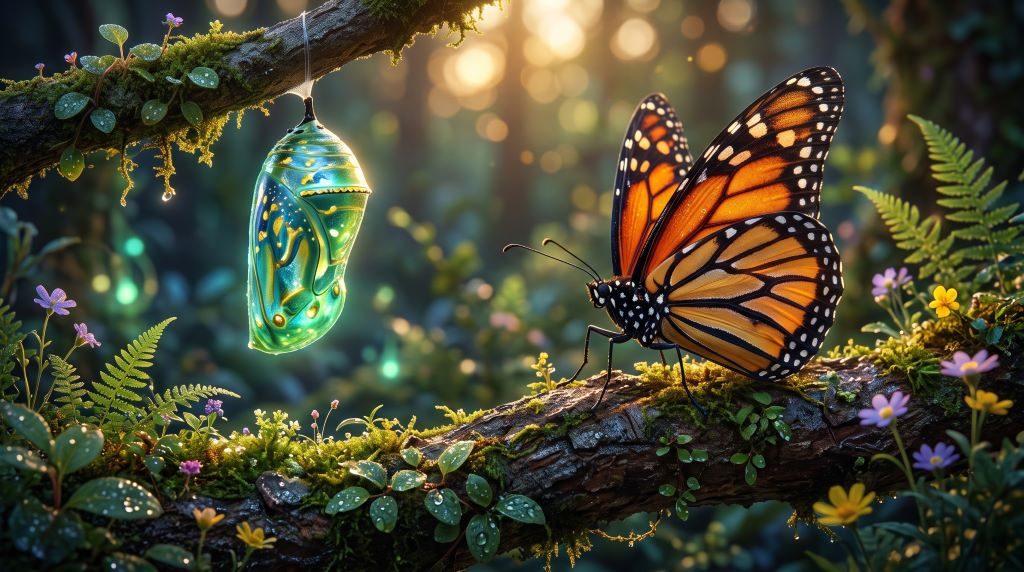
The design for the caterpillar is built into the butterfly.
The design for the butterfly is built into the caterpillar.
(See the article The Potent Paradox for more “Catch-22” examples)
How did evolution choreograph this?
Inside the chrysalis, the caterpillar does not grow wings. It liquefies. It dies. And from that cellular soup, a new being emerges. Or so the conventional story goes! What really happens is a betrayal of continuity; a new life pre-determined; a new form existing for a while only in blueprint.
This does not resemble the traditional account of evolutionary development. It describes a single life existing with multiple intrinsic anticipated designs!
🧬 I. The Imaginal Heresy
🦋 Within the chrysalis, the caterpillar's body undergoes histolysis — a breakdown of its entire “self” in preparation for a new life-form.
🦋 Dormant structures called imaginal discs — present since the caterpillar's embryonic stages — awaken and orchestrate the construction of the butterfly.
🦋 These discs are not extensions of the caterpillar's body. They are architects of another self, new life in a new form, awaiting maturation.
This means that the caterpillar actually contains the blueprint for a creature that it will never become. Its identity is not continuous — it is latent, encoded … and utterly brilliant.
How is this possible if we base our understanding on the evolutionary narratives? It seems the caterpillar has never read “The Selfish Gene”! This is not selfishness, but selflessness. In retroversion, the blueprint for the design of the caterpillar is built into the reproductive genes of the butterfly, just as the reverse is also true!
How did evolution manage this design?
🧠 II. Memory Across the Boundary of Death
- Experiments suggest that butterflies retain certain conditioned responses learned during the caterpillar stage.
- Despite neural reorganisation, fragments of memory somehow persist — a “ghost” in the new machine.
- This challenges the notion that memory is strictly tied to physical continuity.
Implication: Consciousness is evidently more distributed, more resilient, than the materialistic view allows. The butterfly remembers what the caterpillar knew — but how is this possible from the evolutionary perspective?
🌀 III. Ontology in Reverse
Note how these two forms are not complimentary, they are radically different:
- The caterpillar is a devourer, a linear consumer of leaves.
- The butterfly is a pollinator, a cyclical participant in ecological symphony.
- Their behaviours, diets, and ecological roles are not variations — they are ontological inversions.
Implication: This is not gradual evolutionary refinement. It is sudden rupture. The butterfly is not the caterpillar's future — it is its biological opposite.
🦋 IV. Emergence Without Precedent
- No single gene “codes” for metamorphosis. It is a system-level phenomenon with multiple disparate components, triggered by hormonal cascades, embedded biological rhythms, and environmental cues.
- The process is not reducible to parts. It is irreducibly relational.
- The chrysalis is not a container. It's a crucible — where form, function, and life itself are reimagined.
- Note how the materialistic perspective falters when faced with emergence of this delicacy, coordination, and complexity.
- The butterfly is not the sum of its molecules; it's the result of this coordination.
🧘 V. The Philosophical Cocoon
- To call this “evolved” betrays a lack of knowledge of the finer details of the reality of this phenomenon.
- To call it “programmed” is to mistake choreography for mechanistic code.
- The chrysalis is a metaphor for epistemic humility — a place where knowledge dissolves and reassembles.
The process of complete change from one form to another is called holometabilism. Around 80% of insects use this incredible transformation mechanism, including beetles, flies, bees, ants. In fact, about 60% of all earth's animal species use holometabolism, living through different phases of their lives in completely alternative forms.
Caterpillars come with built-in blueprints for the creation of butterflies. These instructions are contained, in complete form, within the caterpillar's body itself and in the imaginal discs.
During the feeding process, caterpillars can grow up to 100x their original size, sometimes eating more than 100 leaves per day. They shed their skin multiple times. During this time, the metamorphosis stage actually begins!
Researchers have examined caterpillars and found tiny immature wings inside them! This runs circles around the standard description of “whole” caterpillar bodies dissolving into juice inside a chrysalis and then a butterfly ultimately emerging!
Some of the “parts” that will belong to the future butterfly are already growing within the caterpillar. These parts are of no use to the caterpillar, but will eventually form part of the anatomy of the butterfly. Even the butterfly's eyes and “future” reproductive organs are there, developing gradually inside the caterpillar's body! — (See the article "Daddy, where do babies come from?")
These organs are waiting for specific signals that tell them when to grow fully. Is this fortuitous, or is it rather evidence of planning?
Once the caterpillar has reached a pre-determined growth, a hormone called ecdysone is released that tells the caterpillar to stop eating and to search for a place suitable for the final transformation stage. This is called a pupa, a stepping stone to the final butterfly stage.
In other words, the chrysalis “butterfly soup” analogy often used in biology textbooks, is misleading. The ultimate butterfly development has been “planned” all along! During the pupa stage, the unwanted caterpillar cells are destroyed. However, its micro-parts, for example the proteins and enzymes that it consisted of, are recycled! Basically, the pupa eats itself so that the butterfly can live!
Metamorphosis is not simply a collection of undirected fortuitous biological events; it's a highly complex transformation, a multi-faceted intricate transfer of life-supporting functions from one form to another. The butterfly does not evolve; it arrives in a series of planned elaborate routines of multiple transformations — summoned by programmed procedures far beyond the caterpillar's comprehension.
How do these considerations compare to the “selfish gene” theory?
Beyond Orthodox Evolution: A Universal Design Perspective
The body organs wait for specific signals
that tell them when to grow fully.
CAN EVOLUTION BUILD WHAT IT CANNOT SEE?
🟣 How is it that we have such perceptive tastes of delicious foods as well as the human sensitivity of touch ...
... from a process that has no feelings?
🟣 How is it that we see such pervasive beauty around us ...
... from a process that can neither see nor appreciate it?
🟣 How is it that nature has such comprehensive biological hearing systems ...
... from a process that cannot hear?
🟣 How is it that we see such foresight and altruism in reproduction ...
... from a process that has no concept of purpose?
🟣 How is it we have such potentially delightful lives ...
... from a process that is not conscious?