🌿 The Mega-Variety Signature
“Biology is the most powerful technology ever created. DNA is software,
protein is hardware, and life is a coded language.”
— Arvind Gupta, computer scientist.
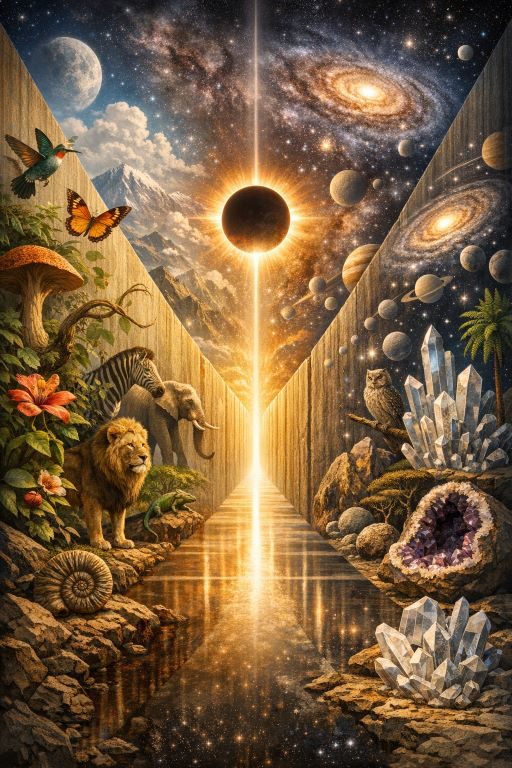
Despite enormous diversity —
There are no creatures
so vastly different
they break the pattern of appropriate form!
We rely on roughly 2,000 available plant species to feed ourselves—a meagre selection drawn from nature's vast pantry. Yet, according to the UK's Royal Botanic Gardens, there are around 400,000 known species of plants on earth, with thousands more being discovered each year. This staggering disparity between what we use and what exists is not an anomaly—it's a pattern; a signature built into the very architecture of nature.
This phenomenon—what we might call the Mega-Variety Signature, the unrelenting diversity of design features—is not confined to botany. It echoes across every scale, every domain, every system of the cosmos:
🐜 Insects:
Over 1 million described species, with estimates suggesting from 5 to 30 million may exist. Beetles alone account for nearly 400,000 species—a taxonomic explosion that Darwin once called “a passion of the Creator.”
🐾 Animals:
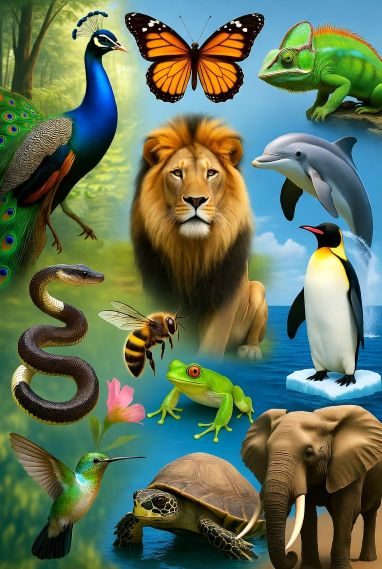
From the microscopic tardigrade to the blue whale, the animal kingdom teems with forms, behaviours, features, colours and shapes so diverse they defy simple categorisation.
🌸 Flowers:
Each petal, pigment, and pollination strategy is a variation on a theme—a spectacle of sublime beauty in a sea of green.
🌍 Planets:
Our solar system is but one among billions, perhaps trillions. The Milky Way alone may host 100 billion planets, each a potential canvas for complex order.
🌌 Stars and Galaxies:
With trillions of galaxies, each containing billions of stars, the cosmos is a fractal example of multiplicity. No two galaxies are the same; no two stars burn with identical fury.
⚛️ Subatomic Particles:
Even at the quantum level, nature avoids simplicity. The “particle zoo” includes quarks, leptons, bosons, and their antiparticles—each with its own unique properties, spins, dimensions, interactions and a raft of other features that produce the sublime poetry of our sustained reality.
🧬The Cell:
Nature's Miniature City of Sublime Complexity: Beneath the lens of molecular scrutiny, the living cell reveals itself not as a simple blob of biology, but as a masterpiece of intricacy, humming with purpose and precision. Far from being the “simple cell” that is often referred to, each cell, even the humble bacterium, is a microcosm—a city of organelles (miniature organs), highways of microtubules (inter-cell scaffolding), and power plants of energy-providing mitochondria, all orchestrated by the silent symphony of genetic code.
DNA coils like a cosmic script, encoding not just function but memory, diversification, and measured potential. Ribosomes read this script like ancient scribes, translating sequences into the proteins that protect and chaperone life. Vesicles shuttle cargo with logistical finesse, while membranes negotiate the delicate diplomacy between inside and out. Even the simplest prokaryote is a marvel of biochemical engineering, its architecture more elaborate than any human invention.
And yet, this entire panorama of function and form unfolds within a microscopic space invisible to the naked eye—a reminder that complexity is not a matter of scale, but of specified order. The cell is a testament to the detail, diversity, and consistent form of nature.
👉 Conclusion
This mega-variety is not merely finely balanced; it's a choreography of elegant form. There are no creatures so vastly different that they break the pattern of this form; no creatures with multiple unnecessary limbs, or bulbous clusters of redundant eyes sprouting like overgrown chandeliers; no torsos split into asymmetrical halves, one side dragging a tangle of vestigial arms like abandoned scaffolding.
We do not see animals whose mouths gape sideways across their bodies like torn curtains, or whose legs branch fractally into unnecessarily smaller legs, each ending in yet smaller legs. There are no birds with wings subdivided into unnecessary flimsy sub‑wings, fluttering like a stack of loose papers in the wind. No fish with spiralling, corkscrew spines that twist their bodies into unusable knots. No mammals with necks that fork into two competing heads, each unsure which direction to lead the body. No human genetics that produce permanently odd forms that are grotesque and alien.
Left to the randomness of undirected evolution, why are there no creatures with antennae erupting in chaotic thickets, or faces arranged with features shuffled like a misprinted deck of cards? It could have filled forests with beings whose proportions are so wildly mismatched—tiny heads on colossal bodies, or limbs so elongated they drag behind like ropes—that their very movement would be a mock distortion.
It could so easily have littered the world with forms accidental, unedited, or needlessly baroque.
But it did not!
Instead, even in its “strangeness,” nature manifests a controlled beauty of form. It prunes. It composes. Its eccentricities are purposeful, its oddities either functional or aesthetic, its deviations from symmetry restrained by a consistent logic. The result is a world where diversity is manifestly intentional, where even the bizarre retains a calibrated measure of coherence, and where beauty is not an exception but a consequence of the rules.
This mega-sized variety is not mere abundance due to random unintentional growth—it is a grand statement. The design of the cosmos is not content with one solution, one form, one path. It proliferates. It diversifies. And in doing so, it reveals a deeper truth: that organised diversity of consistent form is not the exception, but the rule.
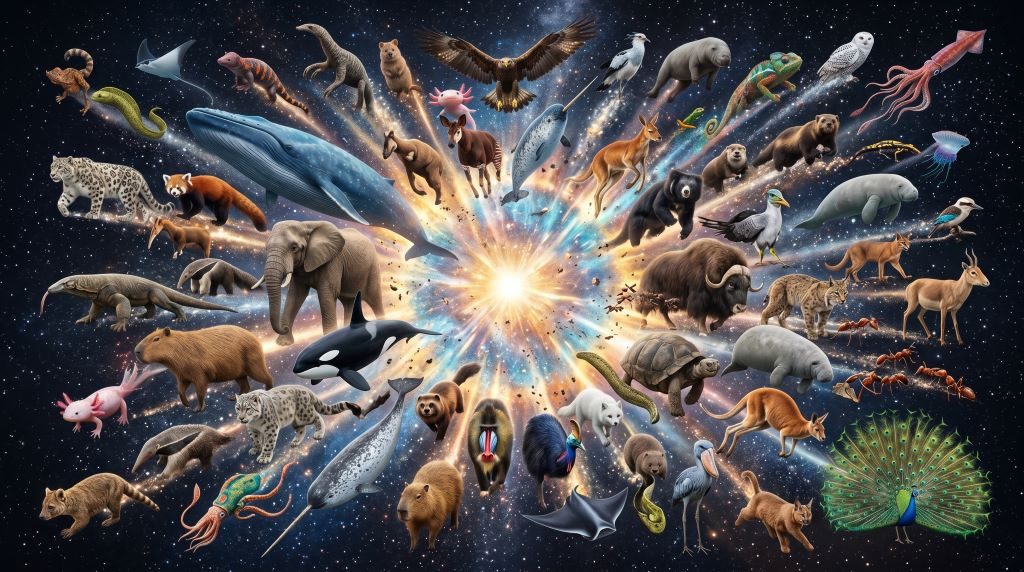
How can evolution effectively
account for this diversity
—yet consistency of form—
of life on earth?
(See a greater hurdle for orthodox evolution in the article:
The Symphony Before the Composition)
