
🌱 Our Personal 19-Instrument Orchestra
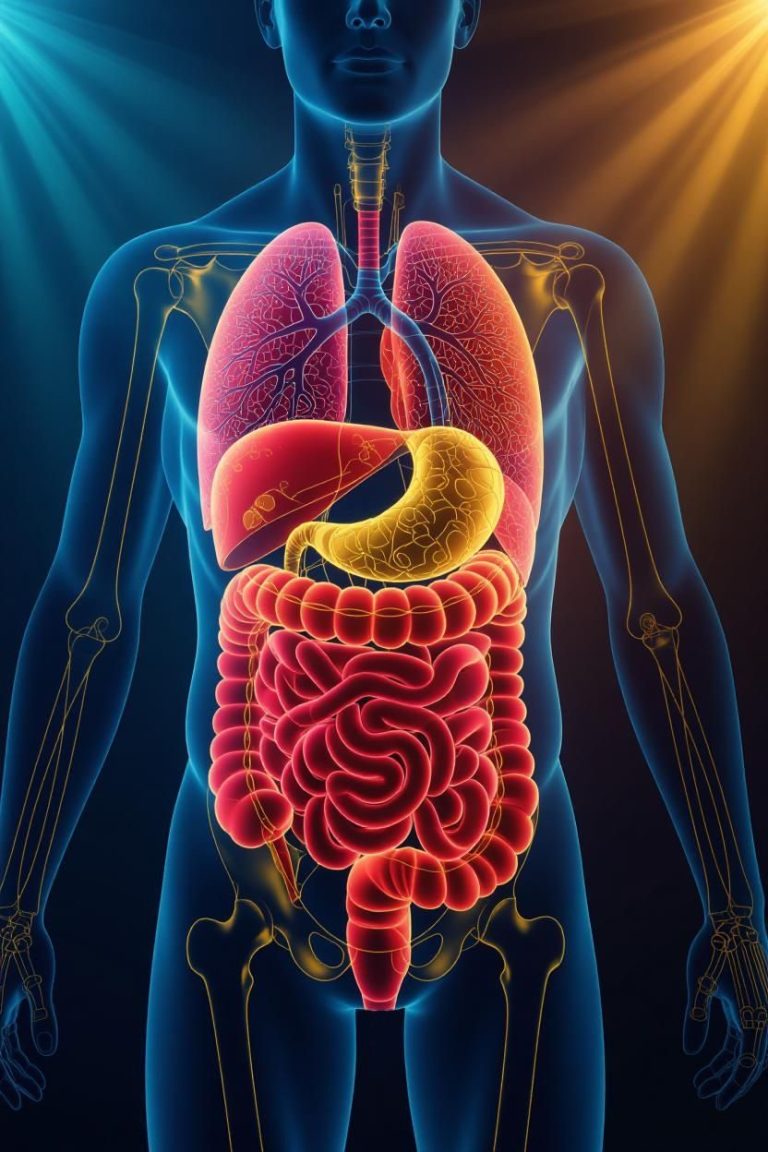
“True is it, my incorporate friends… I am the storehouse and the shop of the whole body. I send [food] through the rivers of your blood… to the court, the heart, to th' seat o' th' brain.”
— William Shakespeare, Coriolanus (1623).
Our internal orchestra that we rarely hear
Every day, without fanfare, nineteen distinct instruments—organs, glands, tissues, chemical pathways, microbial partners—tune themselves to a single purpose: to turn the delightful food we eat into the energy and materials that keep us alive. They work in sequence and in parallel, passing their part of the “score” from one to the next with a coordination and precision no human engineer has ever matched.
Shakespeare sensed this hidden symphony long before modern biology gave it names. “I am the storehouse and the shop of the whole body,” he wrote in the quotation above, imagining the digestive system as a bustling marketplace feeding the “rivers” of the blood and the “court” of the heart and brain. He did not take this amazing choreography for granted.
Today, we often do.
Yet the deeper we look, the stranger and more intricate the arrangement becomes. How did each of these multi‑layered, interdependent systems arise? What kind of process could assemble not just organs, but timing mechanisms, feedback loops, chemical messengers, and supporting microscopic structures—all of which must be present and functioning together before the whole can work at all?
This article explores that question. It examines nineteen “instruments” of human nutrition not as isolated curiosities but as a single, interlocking design—a system whose unity is as astonishing as its complexity.
How did this complex arrangement originate without a blueprint? Could it have evolved gradually, with these “mini-systems” being added incrementally over time? The traditional view is that these multiple small, incremental changes took place over eons of geological time! But how could the overall system work unless all of its components were present and fully functioning?
Can undirected processes really produce such elegant interactivity that provides a vital function, using many disparate systems for a single purpose?
Of particular interest is the critical role that our internal microbiome population plays in this. How did these microbes come to interact successfully by means of a multiplicity of essential functions without which we could not survive? How is it that these microbes, “foreign organisms,” begin their various cooperative functions while our bodies are still developing inside the womb?
Note this summary of the stages of nutrition assimilation:
🎼 STAGE 1: Sensory Priming & Mechanical Breakdown
Mouth, Tongue, Teeth, Salivary Glands, Pharynx
Interactivity: Taste receptors trigger anticipatory responses in the stomach and pancreas via neural signalling—a kind of biochemical forewarning.
🎶 STAGE 2: Transit & Gastric Processing
Oesophagus → Stomach
Interactivity: Gastric stretch receptors signal satiety and stimulate the release of gastrin (a specialised hormone), which primes the pancreas and liver for their upcoming roles.
🎸 STAGE 3: Enzymatic Orchestration & Emulsification
Liver, Gall Bladder, Pancreas, Duodenum
Interactivity: The duodenum acts as a command centre at this stage, releasing secretin and cholecystokinin (another important hormone) to regulate bile and pancreatic enzyme flow.
🎺 STAGE 4: Absorption & Microbial Collaboration
Jejunum, Small Intestine Villi, Microbiomes
Interactivity: Microbial metabolites (like short-chain fatty acids) influence liver function, immune signalling, and even brain chemistry—a true symbiotic feedback loop.
🧹 STAGE 5: Waste Management & Water Recovery
Large Intestine, Appendix, Kidneys, Spleen
Interactivity: The gut–kidney axis links hydration status and microbial by-products to renal function—a subtle but vital regulatory loop.
🧩 Systemic Integration
Liver, Pancreas, Microbiomes, Kidneys: These organs form a metabolic quartet, constantly exchanging signals between themselves via hormones, metabolites, and neural activity. And one of these, the microbiomes, do not even belong to us! Together, our friendly bacteria regulate vital processes: blood glucose, lipid profiles, amino acid availability, detoxification, etc.—all essential for cellular nutrition and the systemic homeostasis (internal harmony) of the whole body.
In particular, consider the “neural activity” required for the multitude of simultaneous processes occurring constantly. How could evolution, a process that has no “feelings,” coordinate these sensitive tasks?
As remarked above, could unmanaged processes really orchestrate such elegant interactivity that fulfils a single vital purpose? — (See further examples in the article 'Symbiosis in Living Things' available in the book.)
Could unmanaged processes
coordinate such elegant and complex interactivity that fulfils a
single vital purpose?
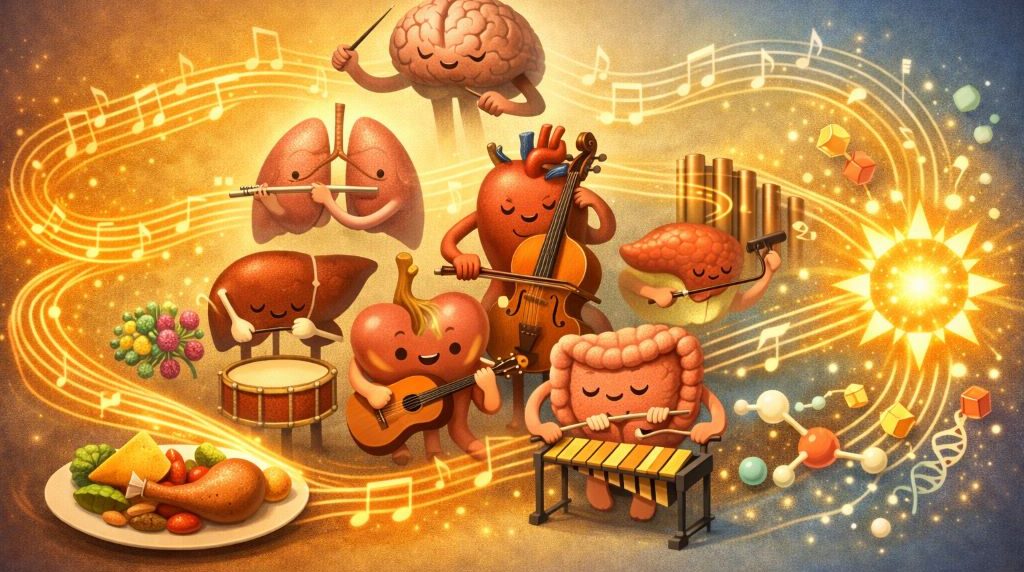
By one count, 19 distinct “instruments”
of the body's nutrition-management system
work as one seamless whole, pursuing a single purpose
via a depth of integration and precision
that remains beyond the reach of human engineering.
Evolutionists refer to “gradual, incremental changes”
in the development of this system —
. . . Could this really have worked?
How could the above system succeed unless
all of its components
were present, harmonious, and fully functioning?
(See a greater hurdle for the theory of evolution in the article:
The Symphony Before the Composition)