
🩸 A Symphony of Many Instruments

“The heart is the household divinity which, discharging its function, nourishes, cherishes, quickens [gives life to] the whole body, and is indeed the foundation of life, the source of all action.”
— William Harvey, the “father of modern circulatory science.”
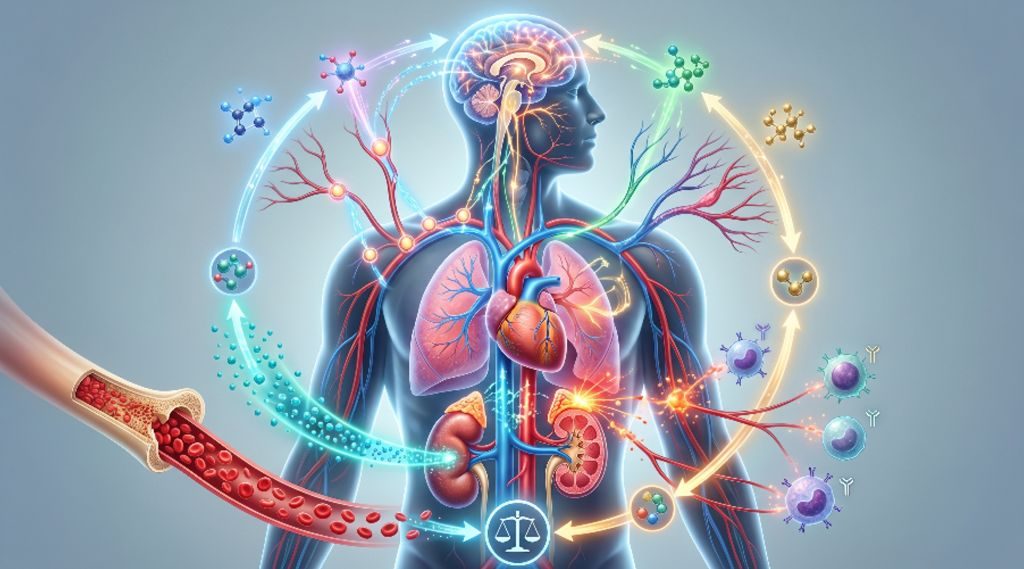
Our body's circulation system is an engineering marvel! But the maintenance and management of blood—life's vital fluid—is not the work of a single organ, but a coordinated arrangement of many parts. For example:
- the heart propels it,
- the lungs enrich it with oxygen,
- the kidneys filter its waste,
- the spleen recycles its ageing cells,
- the bone marrow forges its cellular components,
- while the thymus and the hundreds of lymph nodes shape its immune intelligence;
- even the digestive system plays a starring role, producing the plasma that makes up over half our blood's volume.
But the above is only part of the story!
Each respective organ contributes many microscopic elements, but provides only one piece of the overall puzzle; yet all of this serves one purpose: sustaining the lifeblood that nourishes, defends, and connects every part of our bodies.
Many organs—One vital function—One extraordinary fluid!
🧩 Intricate Coordination
This coordination is not linear—it's dynamic, adaptive, and deeply interwoven. Here's an overview of the interplay:
1. Circulatory Integration
- The heart acts as the central pump, distributing blood to all organs.
- Arteries and veins serve as conduits, while capillaries allow exchange of gases, nutrients, and waste.
2. Gas Exchange and pH Balance
- The lungs oxygenate blood and regulate pH via CO₂ removal.
- This oxygen-rich blood fuels cellular metabolism across all tissues.
3. Filtration and Osmoregulation
- The kidneys monitor blood composition, filtering out toxins and balancing electrolytes.
- They respond to hormonal signals (e.g., ADH, aldosterone) to adjust blood pressure and volume.
- Osmoregulation is the biological process by which organisms keep their internal water and solute concentrations within a stable, life‑supporting range. It's how cells avoid swelling, shrinking, or becoming chemically unbalanced.
4. Cellular Renewal and Recycling
- The bone marrow continuously produces new blood cells.
- The spleen removes aged or damaged cells and recycles iron.
5. Immune Surveillance
- Lymph nodes and the thymus coordinate immune responses, using blood as a transport medium.
- White blood cells patrol the bloodstream, ready to respond to threats.
6. Nutrient and Plasma Synthesis
- The digestive system absorbs nutrients that enter the bloodstream.
- The liver synthesises plasma proteins, clotting factors, and detoxifies harmful substances.
7. Hormonal Regulation
- The endocrine system fine-tunes blood production and pressure via hormones such as:
- Erythropoietin (from kidneys) → stimulates red blood cell production.
- Cortisol and adrenaline → modulate immune and circulatory responses under stress.
🧠 The Hidden Conductor: Neural and Hormonal Feedback
- The brainstem monitors blood pressure, oxygen levels, and pH via baroreceptors and chemoreceptors. — (See the article 'Fingertip Sensitivity—Calibrated or Fortuitous?' for additional info.)
- It sends signals to adjust heart rate, respiration, and vascular tone.
- Hormonal feedback loops (e.g. renin-angiotensin-aldosterone system) ensure homeostasis (our body's internal harmony).
How did a system this diverse and intrinsically essential evolve without either coordinated arrangement or an initial blueprint? The stock answer of evolutionists is that it “emerged gradually,” with these “mini-systems” being added incrementally over enormous geological timescales. . . . Really?
In practical terms, how could the overall system work successfully unless all of the above essential components (including the completed growth of blood vessels spanning literally 100,000 km per body) were present, fully developed, and adequately functioning? — (See also the article 'Daddy, where do babies come from?' for additional info.)
All these system members (components) are required to be working effectively—at the same time—for our well-being, and most of them are required—at the same time—for our survival! Indeed, the principles offered by the evolutionary narratives include “selection” of forms that are superior; but why would a component that is only partially developed, and therefore entirely functionally deficient, be selected?
Is it really possible that unmanaged processes produced such elegant and complex interactivity, using components that include the shared goal of the fulfilment of a single vital purpose? Even though its proponents may voice their faith in the theory of evolution, where is the empirical evidence that supports it? — (See also the article 'Multiple Distinct Laws for One Function' for additional examples.)
Did you know? If all the blood vessels
from one human body
were laid end-to-end,
they would encircle the entire earth
more than twice over!
How could a blind
undirected process arrange
for all of our body's cells
to be fed life's vital fluid?
Could unmanaged processes coordinate
such elegant and complex
interactivity that fulfils a
single vital purpose?
Development by gradual, incremental changes? . . . Really?
How could the above overall system succeed
unless all of its components
were present, harmonious,
and fully functioning?
(See a greater hurdle for the theory of evolution in the article:
The Symphony Before the Composition)