
⚡ The Amazing Strategy of Life's Energy
'The Electron Transport Chain is the cell’s hidden furnace—a silent
conversion of falling electrons into the fire of life.'
— summary of the work of Albert Lehninger (bioenergetics pioneer).
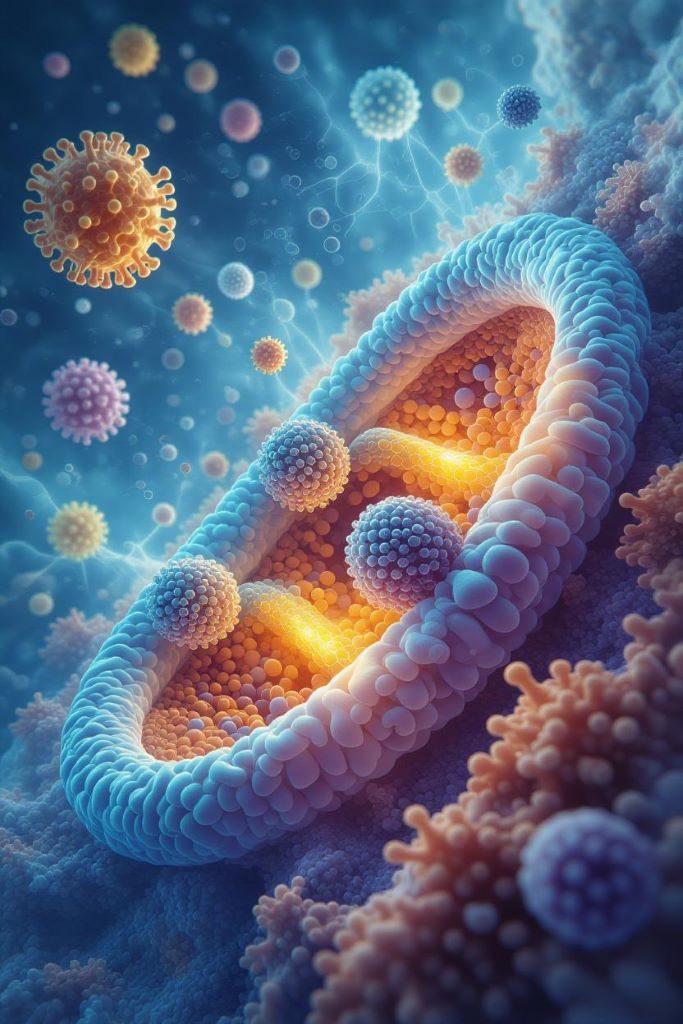
Inside almost all of our cells there's a hidden powerhouse: the Electron Transport Chain. It's not just chemistry—it's a microscopic relay race where electrons leap, protons surge, and protein machines hum with purpose. This tiny corridor of reactions turns raw potential into the energy of life itself, with a precision that makes simple evolutionary stories look naïve. It's choreography, not chaos—a molecular performance so intricate it outclasses the finest engineering humanity has ever achieved.
🧬 Specified Complexity Beyond Evolution
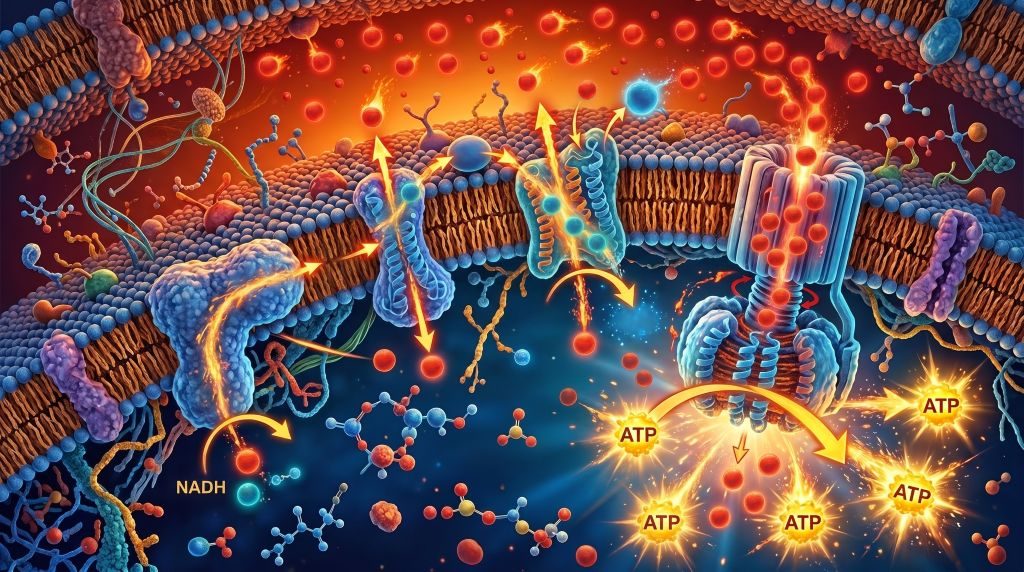
The Electron Transport Chain (ETC) comprises a series of protein complexes embedded in the inner membrane of our cells, each tasked with passing electrons down an energy gradient while pumping protons across the membrane. This proton gradient powers ATP synthase, the molecular turbine that produces the cell's energy currency: ATP.
But this system is not modular in the way a Lego® structure might be. Its components are interdependent, finely tuned, and functionally meaningless in isolation. Remove one complex, and the chain collapses. Alter the proton gradient, and ATP synthesis (energy production) halts. The ETC is a system that only works when all parts are present and correctly configured and calibrated.—(See the ETC-related questions in the 'Quiz'.)
🔁 The Impossible Catch-22!
Here is the ultimate Catch-22 conundrum: the ETC, i.e. the Electron Transport Chain, is required in order to generate energy, yet high energy is needed to build the Electron Transport Chain in the first place! This chicken-and-egg dilemma raises profound questions about the stated origins of such a system.
How could this highly complex process evolve incrementally if the energy required to sustain the multiple steps of its development was only available after the completion of the entire system?
This paradox is not merely rhetorical. It challenges the plausibility of a purely Darwinian, step-by-step emergence of life and its components. Without sufficient energy (ATP), there is no protein synthesis, no membrane maintenance, no cellular viability. And yet, energy production depends on a fully functional Electron Transport Chain. The energy to build the system is locked inside the system itself.
🔭 Foresight in Molecular Architecture?
Some researchers have proposed that ancient minerals or protocells “may have” mimicked aspects of the ETC before biological proteins evolved. While intriguing, these models remain speculative and fail to account for the specificity and efficiency of our body's complex Electron Transport Chain; they lack empirical evidence. They also overlook the additional complexity of protein origins (see the article 'The Symphony Before the Composition'.) The idea that such a system could arise from random mutations over millions of years, without any guiding principle or target purpose, strains credulity.
The ETC is not a haphazard assembly of parts—it's a system that seems to anticipate its own needs. It builds gradients, harnesses them, and channels energy with exquisite control. This suggests not just complexity, but ingenuity. And such ingenuity, in any other context, implies foresight.
🧪 Challenging the Gradualist Assumption
Mainstream evolutionary biology often assumes that complexity arises through incremental changes filtered by natural selection. But the ETC resists this narrative. Its components are not merely additive; they are synergistic. The system's functionality emerges only when the whole (the sum total of working components) is present. This challenges the notion that such a process could evolve gradually, one mutation at a time. — (See also the article 'The Symphony Before the Composition'.)
[Some science stuff:] Recent studies by evolutionists have discovered some ETC components in what they call the 'last universal common ancestor' (LUCA), suggesting that the system—or at least some of its scaffolding—was present very early in history. But this only deepens the mystery. For example, partial chains would leak electrons, producing toxic radicals without the full (complete) system's safeguards. The step-by-step transfer of electrons prevents uncontrolled energy release, which could damage the cell, while harnessing it to create an electrochemical gradient.
[Technical Note 1:] An “electrochemical gradient” can be summed up by two principles:
- A concentration difference (too many particles in one place and too few in another).
- An electrical attraction (opposite charges attracting each other).
By way of illustration, an electrochemical gradient is like a crowd of people standing at the top of a hill while also being pulled by a powerful magnet. The people naturally want to spread out because they're crowded, and they are also being pulled in a particular direction by the magnet. The combination of these two influences creates a strong tendency to move.
[Technical Note 2:] The Q-cycle in Complex III exemplifies the principles of managed design: it ensures maximal proton pumping per electron pair, optimizing energy yield. Similarly, ATP synthase's rotor-stator mechanism converts proton flow into rotational energy, phosphorylating ADP with impressive efficiency.
Such features are not superficial; they are essential for cellular survival (and consequently the survival of the creature), as disruptions lead to catastrophic systemic energy failure.
Studies in primates are often presented by evolutionists as evidence of adaptive refinement, yet what they reveal are adjustments within already intricate biochemical architectures—not the origin of that architecture itself. Invoking millions of years as a catch‑all explanation for highly coordinated molecular systems overlooks a basic principle: time, by itself, does not generate multi-part ordered complexity. More often, it erodes it, as entropy steadily pushes systems toward disorder unless guided by specific, directed processes.
- If ETC-like mechanisms existed near the origin of life, what was the driver for their emergence, if purpose is not an evolutionary mechanism?
- What energy source powered their construction?
- Why would such a complex system arise at all, unless it was necessary from the outset?
- And even if “necessity became the mother of invention,” where did the design for this invention originate? — (See the article 'Machines Making Machines!' for further info.)
How could this complex
energy-producing system
evolve gradually
if the energy required was
only available after the
completion of the entire system itself?
Enormous “evolutionary time,” by itself,
does not generate ordered,
multi-part,
complex systems!
Development by gradual, “incremental changes”? . . . Really?
How could the above sub-microscopic
energy-producing system succeed
unless all of its components
were present, harmonious,
and fully functioning?
(See a greater hurdle for the theory of evolution in the article:
The Symphony Before the Composition)