
🧩 The Most Intricate Enigma of Them All
“If the human brain were so simple that we could understand it,
we would be so simple that we couldn't.”
— Emerson Pugh, physicist.
The human brain is often described as the most complex object known to science. Eighty-six billion neurons, trillions of interlaced synaptic connections, and a capacity for abstract thought, language, and self-awareness—all packed into a three-pound organ powered by the same wattage as a dim light-bulb.
Yet despite its ubiquity, the brain remains a paradox: a structure so intricate, so singular, that its emergence is failed by the explanatory weaknesses of incremental adaptation and natural selection. (See also the article 'From Atoms to Galaxies to Life').
Is the human mind truly the product of slow, cumulative changes over the enormous timescales claimed by the evolutionary narratives—or does its intricate and expansive architecture suggest something more anomalous?
🧠 The Brain by Numbers
- 86 billion neurons, 100+ trillion synaptic connections.
- Each neuron contains possibly millions of microtubules at any one time that are built, destroyed, and re-built on demand.
- Capable of one quintillion operations per second, yet runs on just 15 watts of power.
- Mapping efforts, e.g. the Human Brain Project (costing €600M over 10 years) still fall far short of reality.
- Concept cells (e.g. “Jennifer Aniston neurons”—highly specific neurons that represent complex concepts, and play a role in forming and storing memories) reveal abstract, symbolic cognition unique to humans, as well as demonstrating that neurons themselves are vastly more complex than previously believed.
🧠 The Evolutionary Narrative: Incrementalism Under Strain
- Evolutionary accounts rely on gradual changes: bipedalism, tool use, social complexity.
- But the leap from animal cognition to human abstraction, language, coherent pragmatic imagination, and symbolic thought, is vast.
- The human brain diverges from other primates not just in size, but in architecture. The neocortex—especially the regions supporting vision, abstraction, and complex integration—and the arcuate fasciculus, which underpins language, show differences that are not merely “more of the same.” Their structure and connectivity are reorganised in ways that enable forms of reasoning, symbolism, and communication that no other primate approaches. These are qualitative shifts, not quantitative tweaks—the neural foundations of the vast cognitive distance between humans and animals.
🧠 The Gulf Between Humans and Animals
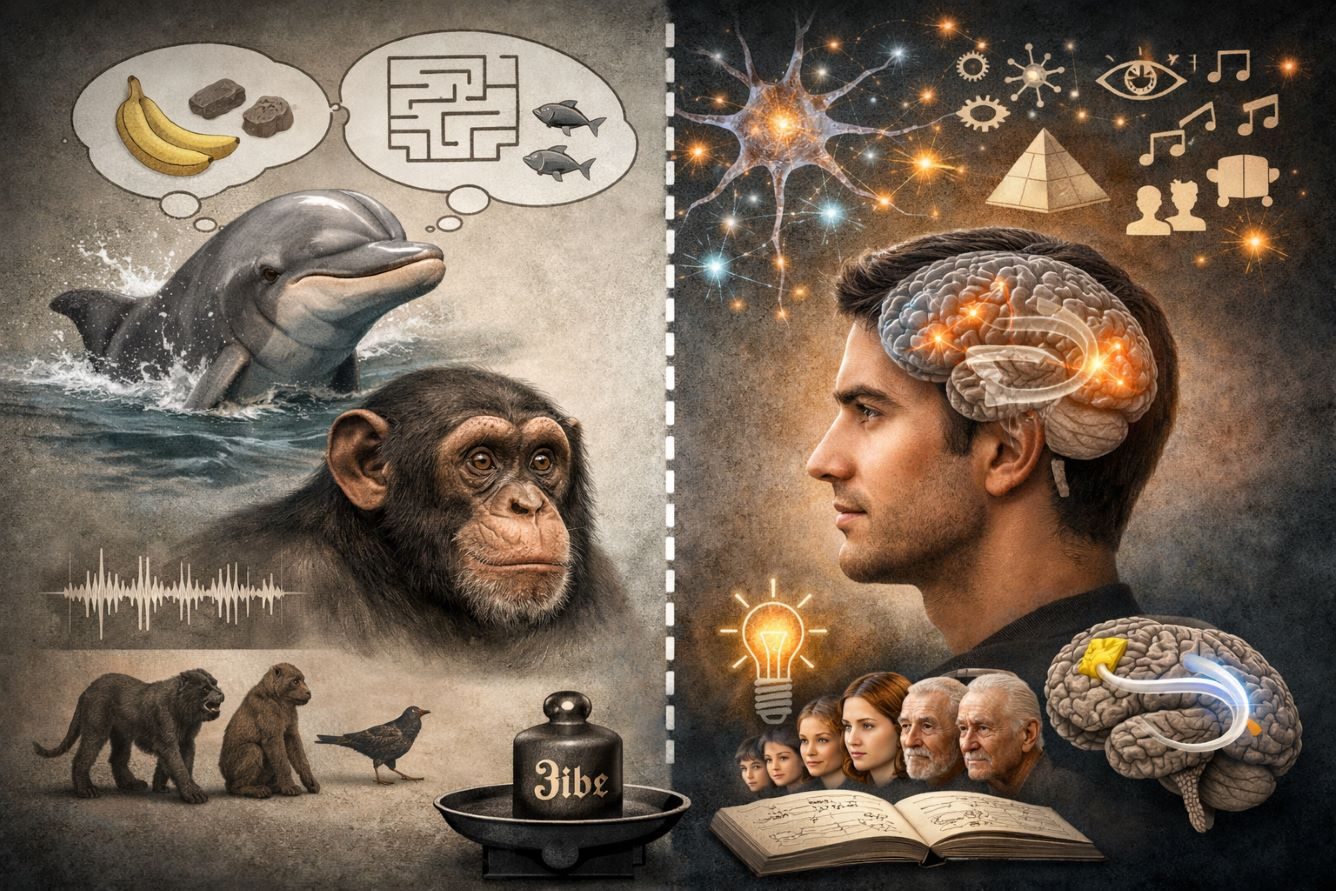
- Even the most intelligent animals (e.g. dolphins and chimps) lack recursive language, abstract reasoning, and cultural transmission.
- Human brains exhibit unique features such as concept cells, deep temporal integration, and symbolic memory.
- The temporoparietal junction (social cognition and attention) and arcuate fasciculus (language functions) are hard-wired for complex social inference and language—far beyond that of animals. — (See also the section 'Infinite Time, Monkeys, and Typewriters!').
🧠 In Conclusion
- Is the brain really the result of trillions of fortuitous incremental changes—each one improving the brain and adding to its intricacy?
- A prominent neuroscientist remarked: “You just don't see in animals the elaboration of parts of the brain involved in context and planning.”
—Associate professor of neurobiology and ophthalmology, Andrew Huberman. - The brain is not merely complex—it manifests organised complexity, layered with interlocking logic, memory, emotion, and abstraction.
- Evolution does not feel, see, or strategize. Yet it is said to have vested humans with all of these and more!
If evolution is a sculptor, the human brain is by far its most improbable masterpiece!
Is the brain really the
result of trillions of
fortuitous ... contiguous ... favourable
incremental changes?
Evolution does not feel, see, or strategize.
Yet it is said to have vested humans
with all of these and more!
(See a greater hurdle for the theory of evolution in the article:
The Symphony Before the Composition)