
🧬 Are Humans Really the Pinnacle of Evolution?
“I choose to believe in that which I know is scientifically impossible; spontaneous generation.”
— Dr. George Wald, Nobel laureate in biology.
Humans are often crowned—sometimes smugly—as the “pinnacle of evolution.” A flattering idea! But let's pause before we polish that crown.
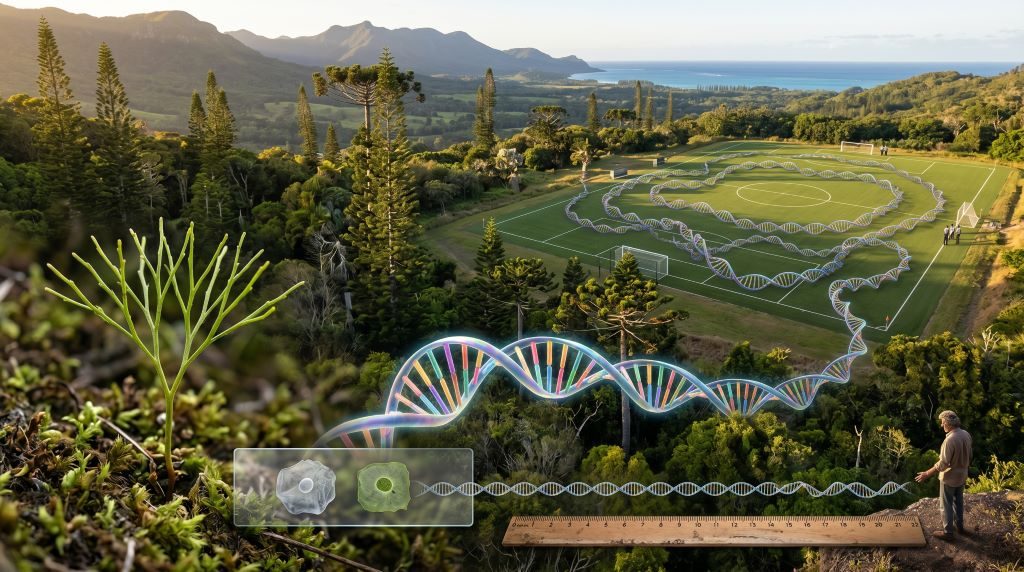
Consider a quiet resident of New Caledonia, a string of beautiful islands in the South Pacific: the fork fern, a fascinating fern-like plant. Unassuming. Ancient. Entirely uninterested in human narratives of progress.
And yet its genome (genetic instructions) contains 160 billion base pairs. Ours? A little over 3 billion; a trifling sum by comparison! If you were to unspool the DNA from a single human cell, you'd get a strand a “mere” 2 metres long. Unspool the fork fern's DNA, and you'd need a football pitch. One cell. One fern. One hundred metres of sub-microscopic genetic text!
So what becomes of the cherished idea that evolution is a staircase, each step taken throughout “millions of years” lifting us a little higher, making us a little smarter, more “advanced,” culminating—naturally—in us?
Evolutionary narratives tell us that plants and animals parted ways roughly 1.6 billion years ago. If complexity is supposed to accumulate slowly, methodically, like a careful architect stacking bricks toward some grand pinnacle, then what are we to make of this botanical behemoth?
Why does a humble fern carry a genomic library fifty times larger than ours?
The usual evolutionary narrative speaks of ascent—of a gradual climb toward greater sophistication.
It's a familiar refrain. But what does it actually imply? Is it a celebration of blind biological tinkering, a triumph of random mutations stumbling into impressive coherence? Is humanity merely the accidental choreography of wandering genes, a fortuitous roll of the relentless cosmic dice?
Or does this story—this persistent human intuition of grandeur—hint at something deeper; something not captured by genome size or anatomical novelty; something that whispers of direction, pattern, organisation?
Perhaps the fork fern, with its sprawling genome, is not an evolutionary embarrassment to be explained away, but a reminder:
- Nature is not a ladder; it's a labyrinth.
- Complexity does not march; it permeates.
- And the idea of a “pinnacle” may reveal more about human psychology than biology.
So the question remains: When evolutionists speak of humanity's ascent, what exactly are they pointing to?
- Multiple biological fortuitous events?
- A narrative convenience?
Or does this describe the outline of a deep and pervasive architecture—one that evolutionary narratives do not successfully account for?
The fork fern's DNA is
fifty times
larger than ours!
How do theoreticians reconcile this
genomic gigantism
in an ancient humble fern with the
slow climb
toward the “pinnacle” of evolution?
(See a greater hurdle for the theory of evolution in the article:
The Symphony Before the Composition)